ع



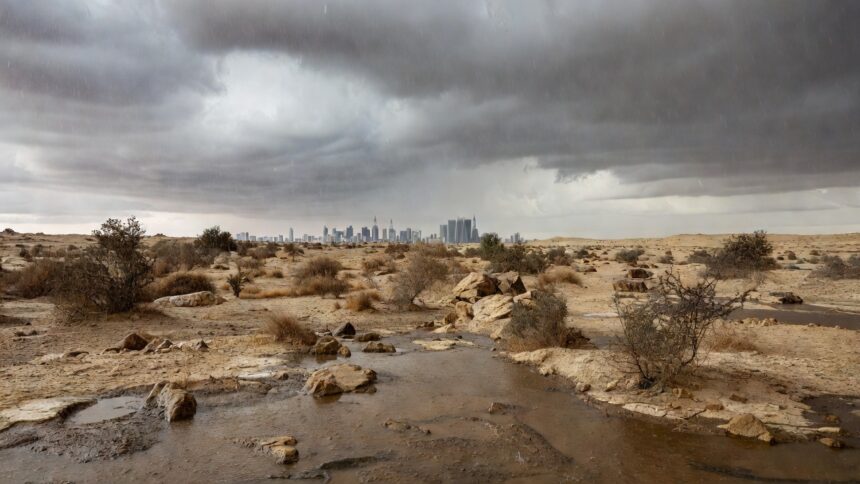
The National Center for Meteorology documented 73.4 mm of rainfall in the Riyadh region as the highest total recorded while six Saudi regions experienced varying levels of precipitation during the 24-hour monitoring period. The center’s network of stations captured the data as part of its routine daily assessments that inform public safety measures and operational planning for government agencies. Civil defense teams have used such reports in the past to coordinate responses in vulnerable locations. A separate assessment published in the journal Water in 2024 placed the Riyadh region’s average annual rainfall at roughly 89.6 mm based on satellite and field measurements between 2001 and 2024. That baseline underscores how the latest single-day accumulation approaches a full year’s typical total and highlights the variability the center routinely tracks across desert environments. The journal article noted that such events generate significant surface runoff that can replenish reservoirs when properly managed.
The National Center for Meteorology maintains an extensive array of hydrological and climatic stations that feed real-time information into its forecasting models and public alerts. Its November 11 update aligns with active red alerts the center issued for parts of the Riyadh region where heavy showers were expected to continue. These warnings emphasize reduced visibility and possible road hazards during intense bursts. Recent comparable reports from the center have shown similar concentrated falls in other regions with totals ranging from 20 mm to more than 60 mm depending on the storm track. The center’s spokesperson has repeatedly stressed in statements that residents should consult official channels rather than unverified social media for accurate precipitation figures.
A review of historical patterns by the same 2024 journal assessment indicated that Riyadh-area rainfall exhibits strong spatial differences with western and southern districts often receiving less than 50 mm per year while central zones average closer to 80 mm. The latest event fits within the winter season’s tendency for intermittent heavy showers that the center has monitored for decades. Such episodes contribute to groundwater recharge but also require coordinated infrastructure readiness according to the study’s authors. The National Center for Meteorology integrates these long-term observations with short-term forecasts to refine its predictive accuracy. Its data collection has expanded in recent years to cover more remote stations across the Kingdom.
The National Center for Meteorology has issued multiple weather bulletins in recent weeks detailing thunderstorm risks and rainfall potential across central and northern Saudi Arabia. Its current monitoring shows continued atmospheric instability that could produce additional accumulations in the coming days. Officials at the center have coordinated with regional authorities to ensure preparedness for any flash-flood threats in low-lying wadis. Historical center records indicate that November events frequently deliver the bulk of the annual precipitation in the Riyadh region. The latest figures will be incorporated into the center’s monthly climate summary to track deviations from long-term averages.
Data from the National Center for Meteorology also supports broader water-resource planning by government ministries that rely on accurate precipitation totals to model dam inflows and aquifer levels. The 2024 journal assessment estimated that individual heavy events like the one recorded can generate millions of cubic meters of runoff across the Riyadh catchment. That volume becomes particularly valuable in an arid climate where evaporation rates remain high. The center continues to upgrade its observation equipment to capture finer-scale rainfall distribution. Its public dashboards allow residents to view station-specific readings in near real time.
The National Center for Meteorology plans to release a comprehensive summary of November rainfall once the full month concludes allowing comparison against seasonal norms. Its ongoing alerts urge caution in areas prone to water accumulation even after the heaviest rain has passed. The center’s role extends beyond measurement to public education about weather safety across all affected regions. Additional station data will be analyzed to identify any micro-climate effects within the Riyadh area. Forecasters at the center will use the information to calibrate models for subsequent weather systems moving through the Arabian Peninsula.