
 ع
ع


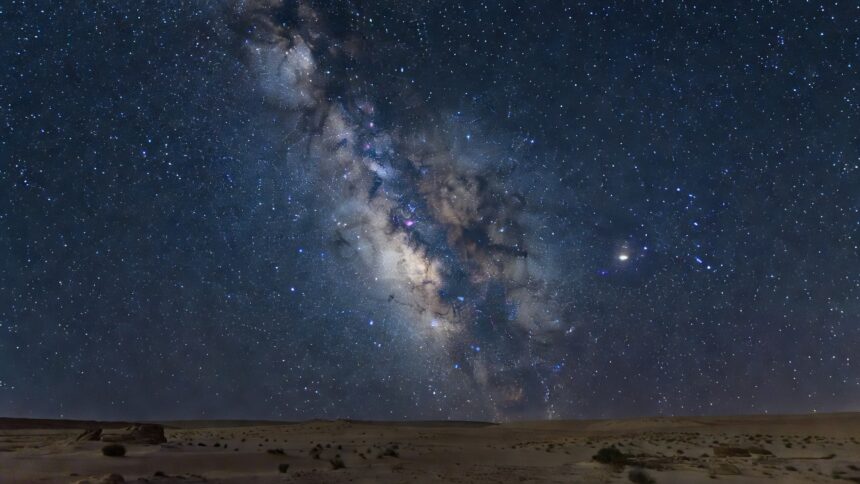
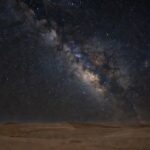
The Saudi Press Agency detailed how the Milky Way’s spiral arm stretched vividly across the night sky above Umm Al-Asafir in northern Saudi Arabia on Saturday night, offering a dense band of stars and stellar clouds visible to the naked eye. Burgis Al-Fulaih, a member of the Afaq Astronomy Society, described the scene to the agency as one where thousands of stars stood out prominently under ideal atmospheric conditions. The location’s open desert horizons combined with exceptionally low light pollution to enable both casual viewing and detailed night photography, marking a notable astronomical event in the Northern Borders region.
Al-Fulaih told the Saudi Press Agency that the start and end of lunar months during July, August, September and October rank among the best periods for Milky Way observation throughout the area. He explained that reduced moonlight at these times heightens the galaxy’s contrast against the dark sky, benefiting both enthusiasts and astrophotographers seeking clearer features. The expert added that desert settings with their naturally dark environments and unobstructed views rank among the strongest locations for witnessing such phenomena either unaided or through telescopes.
The Saudi Press Agency noted that Umm Al-Asafir lies roughly 60 kilometers south of Rafha, where the combination of weather and geography aligned perfectly for the weekend display. Al-Fulaih’s remarks underscored how the absence of significant artificial lighting preserves the visibility of faint galactic structures that often fade in more developed zones. Such conditions have supported repeated observations in Saudi deserts, where similar alignments recur seasonally according to local astronomy records.
According to NASA, the Milky Way is a barred spiral galaxy that contains an estimated 100 to 400 billion stars, with its brightest central band becoming most prominent during Northern Hemisphere summer months when the galactic core rises high in the evening sky. This aligns with the timing highlighted for optimal viewing in Saudi Arabia, where the current period falls within those favorable weeks. The agency’s figures illustrate why remote sites like those near Rafha can reveal intricate details of the galaxy’s structure to observers on the ground.
A assessment from the International Dark-Sky Association places many Saudi desert areas among locations with some of the world’s lowest light pollution levels, enabling visibility of up to several thousand stars on clear nights compared to just a few dozen in urban centers. This context frames the Rafha sighting as part of broader opportunities across the Kingdom for public engagement with astronomy. Al-Fulaih’s affiliation with the Afaq Astronomy Society reflects growing organized efforts to document and share these events with wider audiences.
The Saudi Press Agency account placed the display within annual patterns that recur when lunar cycles minimize interference from moonlight, allowing the galaxy’s arm to appear more defined. Al-Fulaih emphasized the desert’s advantages in preserving dark skies, which support both scientific interest and recreational stargazing across northern provinces. Data from regional astronomy groups indicate that such conditions have drawn increasing numbers of observers to comparable sites in recent years.