
 ع
ع


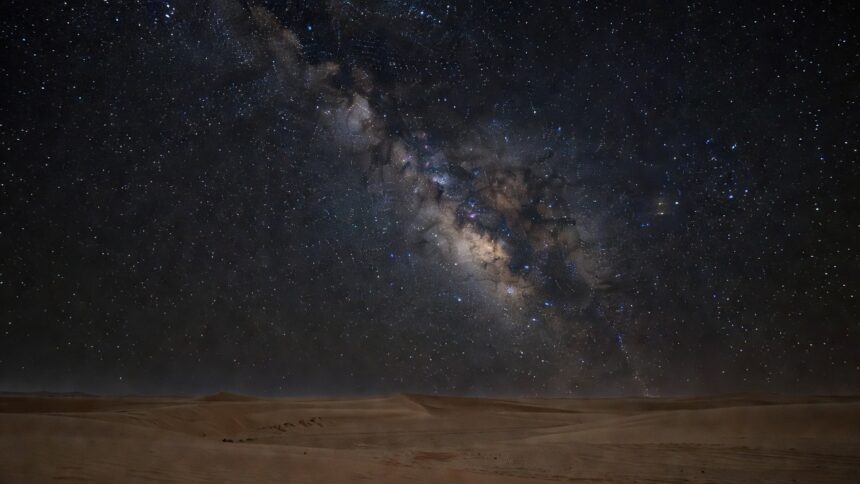
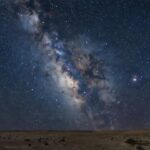
The Saudi Press Agency detailed how the Milky Way’s spiral arm became visible in spectacular fashion over the Umm Al-Asafir area south of Rafha on Saturday night. Burgis Al-Fulaih, a member of the Afaq Astronomy Society, described to the agency a dense band of the galaxy arching across the center of the sky accompanied by thousands of stars and stellar clouds. Ideal viewing resulted from clear atmospheric conditions combined with minimal artificial light in the remote desert location.
Al-Fulaih explained that the start and close of lunar months from July through October rank among the prime windows for Milky Way sightings. Reduced moonlight during those intervals boosts the galaxy’s contrast against the background darkness. Astrophotographers and observers benefit particularly from this alignment which reveals intricate galactic structures.
The Afaq Astronomy Society member pointed to the desert’s inherent advantages including open sightlines free of obstructions and skies largely untainted by urban illumination. A stargazing overview for the Kingdom identifies zones east of Rafha as possessing some of the lowest light pollution readings available.
A review of dark-sky sites in the Kingdom indicates that locations east of Rafha and west of Arar register among the lowest light-pollution levels nationwide. These attributes position northern Saudi Arabia as an exceptional venue for both casual stargazing and serious astronomical study.
Reports from the agency have previously highlighted comparable celestial phenomena in nearby districts such as Al-Sahla where the Pinwheel Galaxy appeared in proximity to the Ursa Major constellation. Such repeated observations affirm the quality of the region’s night skies throughout the year. Enthusiasts increasingly travel to these spots to witness and document cosmic displays.
Al-Fulaih further observed that the absence of significant light pollution allows for naked-eye visibility of features that would otherwise require telescopes in brighter environments. The society encourages broader participation in astronomy to foster greater appreciation of Saudi Arabia’s natural dark skies. Members regularly share their findings to inspire wider community engagement with the night sky.
Local conditions in Rafha and surrounding deserts support consistent opportunities for viewing the Milky Way and other deep-space objects. The combination of geographic factors creates an environment where stellar clouds and galactic arms feature prominently on clear nights. The Saudi Press Agency continues to cover these events bringing them to national attention.