ع



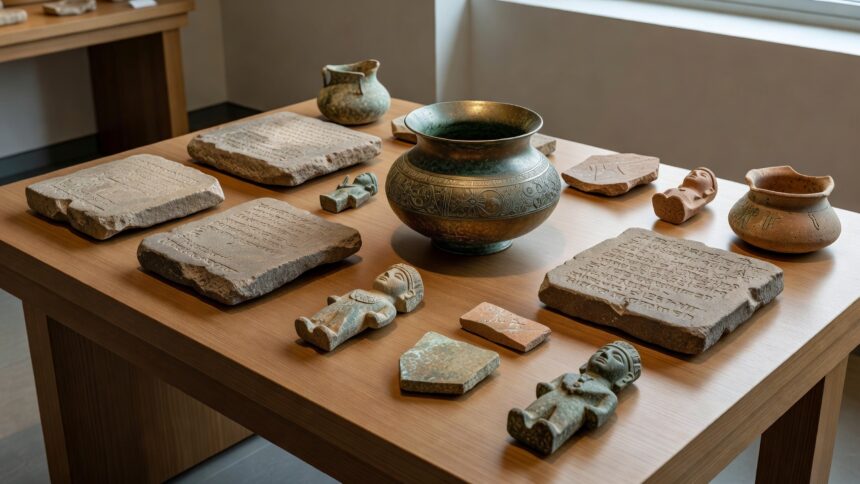
The Saudi Heritage Commission revealed via its official account on the X platform that Saudi Arabia had reclaimed a total of 69634 archaeological artifacts from within the Kingdom and abroad through 2026. The commission’s figures break down to 41057 pieces recovered domestically and 28577 retrieved from overseas with the latter accounting for 41 percent of the overall total. These recoveries stem from coordinated actions under the Kingdom’s Antiquities and Urban Heritage System which regulates possession trade and export while prohibiting unauthorized dealings.
During 2025 the commission secured or accepted 9197 artifacts either through enforcement against breaches of heritage regulations or via voluntary submissions made in cooperation with authorities and private individuals. The body documented 195 violations tied to unlicensed trading of artifacts across social media networks during that period. It also logged 26 separate voluntary citizen initiatives to surrender historical items to designated offices according to the commission’s assessment.
The commission has emphasized international collaboration in its overseas recoveries. One prominent case involved American families who returned 1127 artifacts in 2019 after relatives who worked in the Kingdom during the 1960s had kept them. In another instance a stone tablet inscribed with ancient Arabic texts from the Tabuk region was repatriated from France where it had remained in private hands for around 40 years with Saudi authorities coordinating the handover alongside UNESCO.
Domestic recoveries have frequently relied on voluntary handovers from citizens the commission reported. In Hail province one resident delivered a bronze vessel dating to the Islamic era that featured floral patterns and Quranic verses. A separate handover in Bisha province saw six artifacts surrendered including some from pre-Islamic times among them a stone engraved with verses from Surah Al-Falaq.
The commission’s monitoring extends to online platforms where it tracks unauthorized sales and works to intercept smuggled items before they leave the country. Such actions align with broader national strategies to safeguard cultural property from theft smuggling and unregulated commerce the body stated in its announcement. The 2025 enforcement and voluntary returns represent a continuation of these sustained operations.
By combining regulatory oversight community engagement and cross-border partnerships the commission has built a record of artifact repatriation that spans both recent seizures and long-held items abroad. The authority continues to encourage public cooperation in preserving the Kingdom’s archaeological legacy through proper reporting and surrender of discovered or inherited pieces. Its latest disclosure places the cumulative domestic recoveries at 59 percent of the verified total according to the posted data.