ع



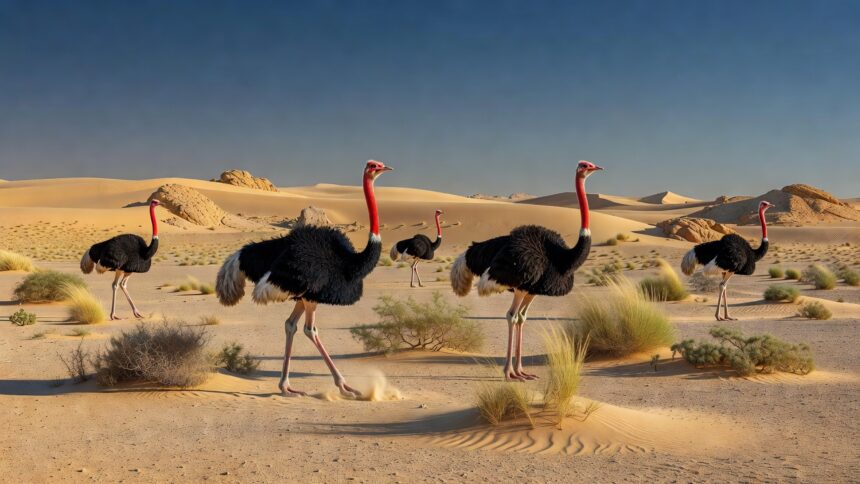
The Prince Mohammed bin Salman Royal Reserve has reintroduced five red-necked ostriches into its protected area in northwest Saudi Arabia, the reserve said in a statement distributed by the Saudi Press Agency. The birds, historically referred to as camel birds, serve as a biological proxy for the Arabian ostrich that disappeared from the region in the early 20th century. This release forms part of the ReWild Arabia initiative, conducted in partnership with the National Center for Wildlife and other royal reserves to rebuild biodiversity.
The Arabian ostrich fell victim to overhunting and habitat loss by the 1940s, according to details outlined in the reserve’s announcement. Red-necked ostriches, native to North Africa and the closest living relative, were chosen for their adaptation to arid desert conditions. The five released individuals are intended to establish a founder population that will support national breeding and restoration programmes.
Andrew Zaloumis, CEO of the Prince Mohammed bin Salman Royal Reserve, described the reintroduction as a landmark step in the statement. “The return of ‘camel birds’ to their historic rangelands supports the restoration of desert ecosystems shaped historically by large grazing and browsing species. Ecosystems can only be considered fully restored when lost species, or their ecological equivalents, are returned,” he said. Zaloumis added that this marks a step toward establishing a founder population for Saudi Arabia’s national breeding and restoration programs.
The ostrich release represents the 12th species brought back to the 24,500-square-kilometre reserve, which already hosts reintroduced Arabian oryx, sand gazelles, mountain gazelles and Persian onagers, the statement indicated. Organisers plan to re-establish a total of 23 historically occurring native species through the long-term effort. The initiative operates alongside Imam Turki bin Abdullah Royal Nature Reserve, Imam Saud bin Abdulaziz Royal Reserve, Aramco, NEOM and the Royal Commission for AlUla.
Saudi Arabia’s National Center for Wildlife has operated a dedicated breeding programme for red-necked ostriches at its Prince Saud Al-Faisal Center in Taif since the late 1980s, centre records show. Earlier reintroductions into the Mahazat as-Sayd Protected Area began in 1994 with birds sourced from Sudan, leading to a population that reached between 125 and 150 individuals by the early 2000s according to National Wildlife Research Center studies. Those projects recorded average annual hatching of 22 to 30 chicks while documenting survival rate improvements exceeding 41 percent after translocation.
The current rewilding aligns with Saudi Vision 2030 and the Saudi Green Initiative goal of protecting 30 percent of the kingdom’s land and sea by 2030, the reserve noted in its announcement. Ostriches function as ecosystem engineers by aiding seed dispersal, controlling insect populations and helping maintain rangeland health for coexisting species. Petroglyphs within the reserve depicting ostriches and ancient hunting scenes provide archaeological evidence of the birds’ former presence in the area.