
 ع
ع


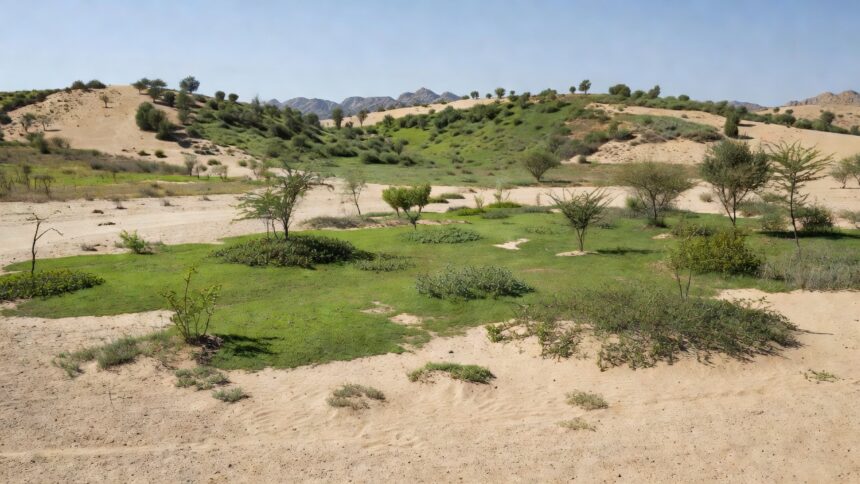
The Secretariat-General of the Middle East Green Initiative said in a statement that the participation will focus on showcasing efforts to combat desertification, restore degraded land and build regional environmental cooperation among the 35 member states. According to the statement, the initiative will highlight practical programs that translate environmental goals into on-the-ground projects addressing land degradation, climate change impacts and ecosystem rehabilitation. The United Nations Convention to Combat Desertification reports that up to 40 percent of the world’s land is degraded, affecting more than 3.2 billion people, a challenge the Middle East Green Initiative seeks to tackle through coordinated action. Mongolia, the host country, has nearly 77 percent of its territory degraded, according to UNCCD data, making the COP17 venue a symbolic choice for global land restoration discussions.
Middle East Green Initiative Secretary-General Eng. Ibrahim Al-Turki stated that the first participation in UNCCD COP17 represents an important opportunity to reaffirm the commitment of its regional member countries to strengthening efforts to restore degraded land and combat desertification across the region. He explained that these efforts represent a shared regional and international responsibility and are a key pillar in advancing action on global climate issues, supporting sustainable development, and protecting the future of communities across the region. Al-Turki noted that cooperation, effective partnerships, and action grounded in science and knowledge can help transform shared challenges into opportunities for lasting impact. The initiative was launched by Saudi Arabia in 2021 as a regional alliance to advance these objectives, according to official descriptions on the Saudi Green Initiatives platform.
A central element of the presentation will be the initiative’s target of planting approximately 50 billion trees, which equates to restoring 200 million hectares of degraded land across member countries, the statement indicated. The Middle East Green Initiative plans to emphasize nature-based solutions for expanding vegetation cover, rehabilitating land and mitigating climate effects on communities and ecosystems. Partnerships with the UNCCD and other international bodies will be strengthened during the conference, with the secretariat seeking to build practical collaborations involving governments, financial institutions, the private sector and civil society. UNCCD COP17 builds on previous sessions, including the 2024 gathering in Riyadh, where participating nations advanced similar land resilience agendas.
The statement added that the initiative will promote knowledge exchange, capacity building and the mobilization of technical and financial resources to develop applicable regional solutions for its member countries. Al-Turki’s delegation aims to engage in dialogue with both regional and non-regional countries as well as scientific organizations to foster projects with environmental, social and economic benefits. These activities align with broader international goals under the UNCCD framework, which has 197 parties working to reverse land degradation trends. The conference runs concurrently with the International Year of Rangelands and Pastoralists, adding focus to sustainable land management practices relevant to arid regions.
Through this engagement, the Middle East Green Initiative seeks to position its model of collective action as a contributor to global efforts against desertification while learning from other participating nations’ experiences. The secretariat’s statement underlined that the region’s diverse ecosystems require tailored approaches that combine traditional knowledge with modern science to achieve measurable restoration outcomes. Data from the UNCCD shows that effective land restoration can significantly bolster food security and economic stability in vulnerable dryland areas, themes expected to feature prominently at the Mongolia gathering.