
 ع
ع


The National Center for Meteorology has forecast that high temperatures reaching as high as 48 degrees Celsius will continue across parts of the Eastern and Riyadh regions on Monday, with the center reporting that Dammam could hit that peak while Riyadh reaches 45 degrees Celsius. Makkah is expected to see 47 degrees Celsius and both Madinah and Jeddah are set for 45 and 44 degrees respectively according to the NCM. Southwestern areas will be cooler with Abha forecast at 32 degrees Celsius, Al-Baha at 31, Jazan at 38 and Najran at 39, all under rain-bearing clouds as per the bulletin.
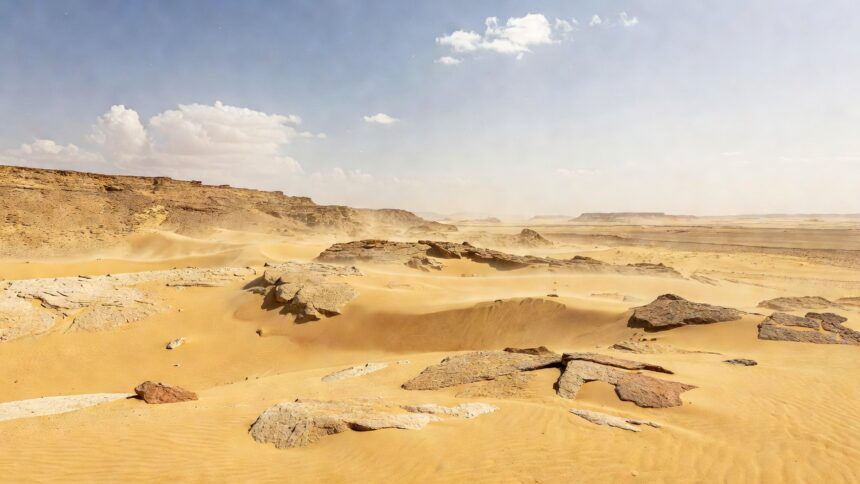
Active winds carrying dust and sand will affect several regions the National Center for Meteorology reported, impacting the Riyadh, Makkah, Madinah, Northern Borders, Al-Jouf, Tabuk, Hail and Qassim areas where visibility could be reduced for travelers. Dust-raising winds are set to persist over western and southwestern parts of the kingdom according to the center’s assessment. Such conditions frequently arise in the arid landscape during peak summer as documented in the National Center for Meteorology’s ongoing observations.
Rain-bearing thunderclouds may develop over southern sections of those western and southwestern zones as well as parts of the Jazan region the National Center for Meteorology indicated in its forecast for August 3, 2026. The center tied the potential for precipitation directly to the cloud formations expected in the southwest where temperatures remain lower than in the interior. This element of the outlook reflects typical late-summer variability in elevated terrain.
High humidity is also anticipated along coastal stretches from Al-Qunfudhah to Jazan the National Center for Meteorology noted, a factor that often intensifies the perceived heat in those areas. The center’s data highlights how proximity to the Red Sea contributes to moisture levels at this time of year. Coastal forecasts form a regular component of the NCM’s regional bulletins.
An analysis by the National Center for Meteorology of patterns between 1985 and 2025 placed the average maximum temperature for July at 40.3 degrees Celsius with comparable readings extending into August across central and eastern provinces. World Bank climate data drawn from 1991-2020 observations confirms Saudi Arabia’s classification as a hot desert environment where summer temperatures routinely exceed 40 degrees Celsius in many locations. The current forecast aligns with these established climatological baselines from the respective institutions.