
 ع
ع


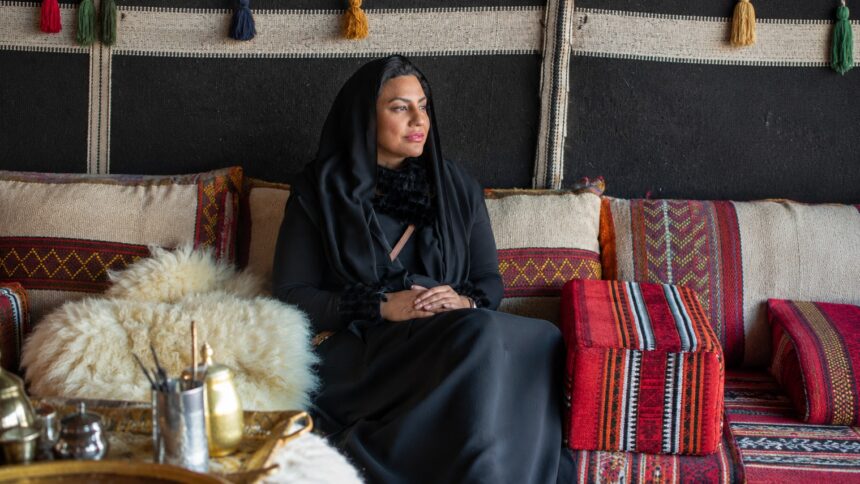
Female participation has doubled to 36 percent and women own 47 percent of commercial registrations. Kholoud Attar incorporated in 2007, and her ledger records what the statistics leave out.
The statistics describing Saudi women’s move into the economy have crossed from progress into precedent. Female labour force participation more than doubled from 17 percent in 2017 to 36.3 percent in the first quarter of 2025, and female unemployment fell to a historic low of 10.5 percent, according to the Ministry of Human Resources and Social Development, comfortably past the original Vision 2030 target of 30 percent. Monsha’at’s SME Monitor for the second quarter of 2025 counts 1.7 million active commercial registrations, with 47 percent owned by women, per Saudi Gazette. The wave is measured to the decimal. What it broke through is not, and for that the useful evidence sits with the small control group of women who incorporated before the reforms existed.
The Market Before the Metrics
Kholoud Attar founded Design magazine in Jeddah in 2007, in her early twenties, building the country’s first design title and the publishing house KAAPH around it. Her accounts of that early market, given on the Jalis podcast, describe its texture: businessmen opening meetings by asking who the man was they would be signing with, her own assistant assumed to be the boss, some counterparts declining to meet her at all.
The conditions outlasted the founding years. In 2019, when Al Wehda Club contracted KAAPH to run its media centre, making Attar the first woman to head a media centre for a Saudi club, per the club’s own announcement reported by About Her, she has recounted that the facility had no women’s bathroom. By her telling, she rationed her water intake for months before filing a formal request, and left the contract with nine women working at the club.
The Ledger
The record built through those conditions reads like a stress test. Design grew from 2,000 copies distributed in Jeddah to 40,000 across the Middle East, and by Attar’s count on the podcast, 322 people have worked through the company over its life. She has described taking a street-signage contract along one of Riyadh’s main roads, running out to the airport, that other vendors refused over a penalty exposure she puts at 10 million riyals. For seven years, by her account, she simultaneously ran Attar Software Engineering, her family’s firm with four decades in the market, during her father’s absence, and today leads a team of 35 across the two businesses, per her Ithra profile. External validation arrived plainly: in 2023, Mastercard and SAB selected her from the Kingdom’s women entrepreneurs for the $30,000 Her Voice grant, as reported by Arab News.
What Participation Data Cannot Count
One honest caveat belongs beside the national numbers. Participation statistics measure entry, not endurance, and endurance is where the first generation’s evidence is hardest and most instructive. Attar has described her company reaching revenues in the millions and later sitting, twice, on an account that did not hold five riyals before she rebuilt it. “I’ve been robbed, cheated on, failed, brought myself up twice,” she said on the podcast. The 47 percent figure describes a cohort whose most difficult data, on survival, does not yet exist.
The Value of Precedent
Context sharpens the point rather than blunting it. Saudi female participation is still climbing toward a world average of roughly 51 percent on World Bank figures, and no major economy has closed such a gap this fast. Speed creates a specific need: precedents. Policy can license a founder; it cannot lend her pattern recognition. That transfers person to person, from the generation that negotiated rooms built without them to the one now filing nearly half the Kingdom’s new registrations. Attar’s current chapter, a design title in its 19th year and a Drb flagship newly opened in Diriyah, is the completed arc the new cohort needs on record: not simply that the door opened, but that the road behind it leads somewhere.