
 ع
ع


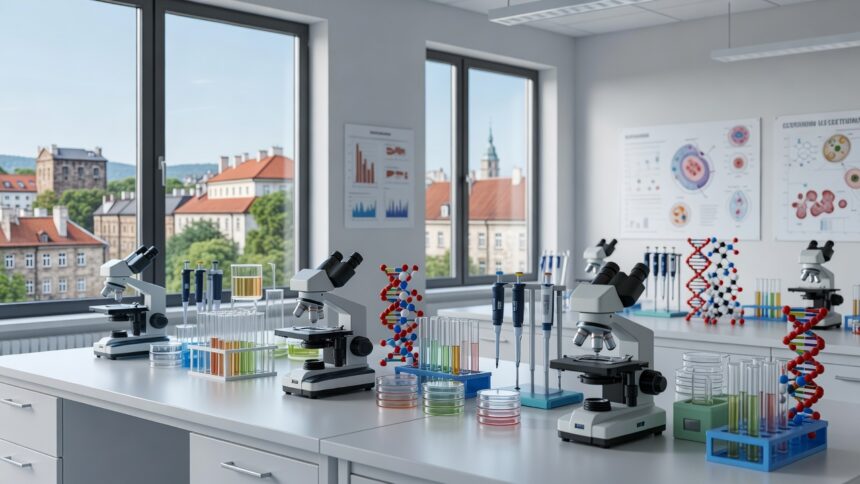
The King Abdulaziz and His Companions Foundation for Giftedness and Creativity, known as Mawhiba, stated in an announcement that its International Olympiads Program had qualified the four students in partnership with the Ministry of Education. The team arrived in the Lithuanian capital for the competition running from July 12 to 19 after completing a series of selection stages that began with the National Science and Mathematics Olympiad. Mawhiba noted that the program focuses on building advanced competencies through targeted preparation to ensure participants can handle the Olympiad’s demanding standards in life sciences.
Mawhiba described the training regimen as encompassing both theoretical instruction and practical laboratory work delivered through specialized forums and residential camps held inside the Kingdom and at select international venues. National and international experts in biology oversaw these sessions to refine the students’ experimental techniques and analytical abilities. The foundation added that this structured approach has formed the backbone of Saudi participation in the annual event, which the International Biology Olympiad association identifies as the premier global contest for pre-university students in the field.
According to Mawhiba records, Saudi teams have taken part in the International Biology Olympiad for several years, building on domestic competitions that identify top performers from schools nationwide. The current group advanced from the initial national round into Mawhiba’s intensive training track, where they engaged with complex topics in cellular biology, genetics, ecology and physiology. Previous Saudi delegations have returned with medals, a pattern the foundation linked to sustained investment in gifted education programs.
The Ministry of Education has collaborated with Mawhiba to expand access to such Olympiad pathways across different regions of the Kingdom, ensuring talented students receive equal opportunities regardless of location. Mawhiba figures indicate that thousands of Saudi youth participate in the preliminary National Science and Mathematics Olympiad each cycle before a small cohort advances to international representation. This year’s biology team exemplifies the selection funnel that prioritizes merit and rigorous preparation over volume.
Mawhiba highlighted that the 2026 edition coincides with the Olympiad’s continued expansion, now encompassing competitors from nearly 80 countries and regions as documented by the official IBO organization. The event tests both individual knowledge and practical skills through multiple rounds of examinations conducted under standardized international rules. Saudi participation forms one element of a wider national strategy to elevate STEM capabilities among young citizens.
In related developments, the foundation coordinates similar programs for other science disciplines including physics, chemistry and astronomy, allowing parallel teams to compete in their respective global Olympiads. Mawhiba reported that these combined initiatives have produced a measurable rise in Saudi medal tallies at international contests over the past decade. The ongoing competition in Vilnius will conclude with awards announced at the end of the week-long program.