
 ع
ع


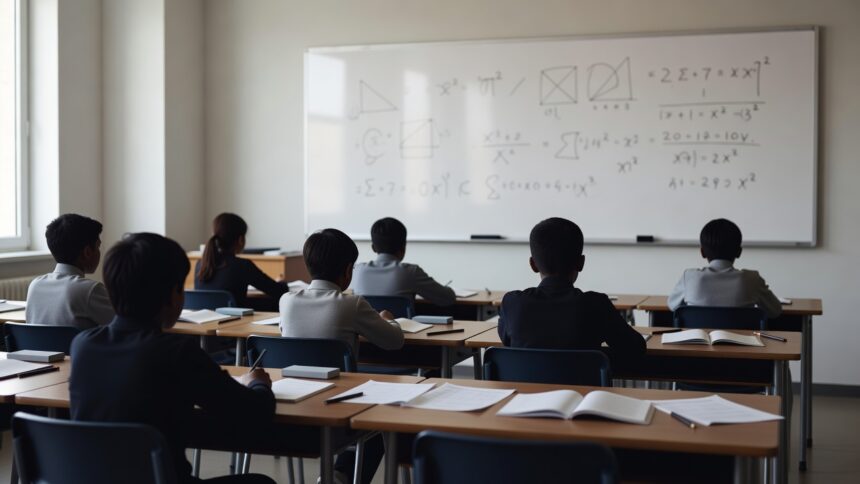
The King Abdulaziz and His Companions Foundation for Giftedness and Creativity, known as Mawhiba, said the Saudi mathematics team is participating in the 2026 International Mathematical Olympiad held in Shanghai. The team consists of six secondary school students who were prepared in partnership with the Ministry of Education. Mawhiba reported that the students progressed through the National Saudi Mathematical Olympiad before entering specialized training forums and a nearly two-month intensive training phase.
Mawhiba’s statement detailed that the intensive training involved national and international experts in mathematical olympiads. The program focused on advanced mathematical concepts along with the development of analytical and creative thinking. Students also learned effective problem-solving strategies to tackle the competition’s challenges.
According to Mawhiba, the International Mathematical Olympiad features two exams conducted over consecutive days. Each exam allows four and a half hours to solve three problems, resulting in six problems total across the event. The questions span geometry, algebra, combinatorics and number theory, testing participants’ abilities in critical thinking, analysis, logical reasoning and creative problem-solving.
Mawhiba stated that the team’s participation underscores the kingdom’s commitment to developing human capabilities. The foundation said the effort aims to strengthen Saudi Arabia’s presence in the fields of science, knowledge and innovation. This aligns with broader national goals to excel in international academic competitions.
A review of past IMO participation by GCC countries from the Gulf Cooperation Council Secretariat shows increasing involvement and achievements in STEM fields over the last decade. Mawhiba has similarly supported teams in biology, physics and chemistry olympiads, with recent successes including multiple awards as reported in related announcements. The mathematics team’s current campaign continues this trajectory of investment in gifted education.
The official IMO guidelines indicate that the competition, established in 1959, brings together the top young mathematicians from more than 100 nations annually. Saudi Arabia has fielded teams in the event for over a decade, gradually improving its rankings through structured preparation programs. Mawhiba’s latest initiative reflects ongoing enhancements to these training methods.
The foundation’s partnership with the Ministry of Education has expanded access to such programs across the country. Training camps and selection processes have become more comprehensive in recent years. These steps have enabled more Saudi students to compete on the global stage with greater confidence.