

 ع
ع


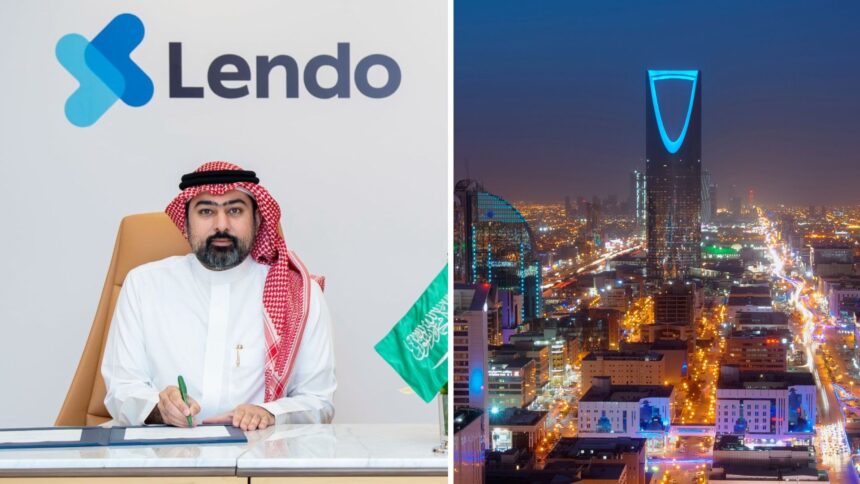
Equity into Saudi startups collapsed in the first half, but the lending platforms are financed from a different market entirely, and Lendo shows what that market pays for.
Saudi startups raised $219 million in the first half of 2026, down 74 percent year on year, according to MAGNiTT. Deal count fell 41 percent, a milder drop that suggests cheques shrank rather than disappeared. The Kingdom’s share of MENA venture capital fell from 49 percent in the first half of 2025 to 16 percent. Across the region, international investor participation dropped 48 percent by count and 65 percent by capital deployed.
One number ran the other way. Fintech’s share of Saudi venture funding rose from 28 percent in 2025 to 67 percent in the first half of this year. That is not because equity investors turned enthusiastic. It is because fintech is where the fewest deals still cleared, and because the largest lending platforms stopped depending on that market some time ago.
The ratio that describes the business
Lendo has raised roughly $35 million of equity since 2019 across a $7.2 million Series A and a $28 million Series B led by Sanabil Investments, the Public Investment Fund subsidiary. Against that sits a $690 million warehouse facility led by J.P. Morgan, signed in January 2025 and supported by Fintech Saudi, a SAR 187.5 million murabaha facility from Jadwa Investment, a SAR 580 million SME Bank agency programme and a SAR 200 million industrial programme with the SIDF investment arm. Roughly twenty riyals of deployable credit capacity for every riyal of shareholder equity.
Chief executive Osama Al Raee has described the funding mix bluntly, saying the platform started with retail crowdfunding and expanded to include “family offices, global banks, and sometimes our own balance sheet.” He has also said the J.P. Morgan line was originally scoped at $150 million before the bank offered more than four times that.
What changes when the funding changes
A platform funded this way is no longer a startup in any useful sense. It is a specialty finance company, and it is priced accordingly: on advance rates, cost of funds, tenor and the shape of its loss curve, not on user growth. J.P. Morgan’s George Deves said at signing that “a strong and fast-growing SME sector is vital for the local economy”, which is the language of an asset-backed desk, not a venture committee.
The wider market is moving the same way. Alvarez and Marsal’s Sam Gidoomal told EnterpriseAM in July that private credit’s role in the Kingdom lies with “some of the newer technology companies that perhaps don’t have proven earnings reports”, companies that banks will only refinance once they can show two or three years of recurring revenue. Saudi banks, on his reading, are not being displaced. They are being complemented at the front end of the credit lifecycle, and international capital is learning the market through those structures first.
What leverage costs
The concession is that the same structure amplifies mistakes. Lendo publishes its own loss data, which more of its peers should, and the disclosure is not flattering in isolation: a total portfolio default rate of 2.82 percent as of 30 June 2026, calculated against total financing extended. Company data cited by SAMA in June put sector default rates at between 1 percent and 1.5 percent. The platforms do not all compute the ratio on the same denominator, but the direction matters: warehouse funders set advance rates against realised losses, and a deteriorating curve tightens the line exactly when originations most need it. Fitch’s April warning on Saudi asset quality under prolonged regional conflict lands harder on short-tenor SME receivables than on mortgage books.
That risk is the price of the alternative, and the alternative is worse. Lendo has flagged an eventual listing since its Series B in 2023, into a MENA IPO market that has spent 2026 in limbo. A lender funded by warehouses, murabaha facilities and government portfolios can wait for that window without the wait being existential. In a half-year when Saudi venture funding fell by three quarters, that is the more interesting capital structure to study.