
 ع
ع


Economy and Planning Minister Faisal F. Alibrahim presented Saudi Arabia’s third Voluntary National Review on the Sustainable Development Goals during the 2026 session of the United Nations High-Level Political Forum on July 14. The document builds directly on the Kingdom’s earlier submissions in 2018 and 2023 while incorporating contributions from more than 140 government, private-sector and civil-society entities, according to details shared by the minister. Alibrahim framed Vision 2030 as the central mechanism that has translated the UN 2030 Agenda into concrete domestic outcomes across economic diversification, social inclusion and environmental stewardship. General Authority for Statistics data from 2023 indicated progress on more than half of the sustainable development indicators tracked nationally, a baseline the latest review uses to measure further advances.
A decade ago the Kingdom stood at an important crossroads between its established economic model and a bolder reform trajectory, Alibrahim told delegates at the forum. “That path was Saudi Vision 2030,” he said, describing the review as the raw story of a journey that began with honest self-assessment and has now entered a phase centered on prioritization, efficient delivery and higher impact. The traditional model had delivered infrastructure expansion and a central role in the global economy yet left the country exposed to oil dependence and public-spending volatility even as a growing young population sought wider opportunities, the minister explained. Institutions required enhanced capacities to regulate, coordinate and deliver in an increasingly complex diversified setting, Alibrahim added.
The labor market has undergone a structural shift since the launch of Vision 2030, with female workforce participation doubling to 34 percent since 2017 and greater numbers of women assuming leadership and entrepreneurial roles, according to Alibrahim. Non-oil activities now constitute 55 percent of real gross domestic product, up from 45 percent at the start of the program, while 74 non-oil sectors posted annual growth exceeding 5 percent over the past five years and 38 of them surpassed 10 percent. These gains reflect broader regulatory streamlining, sector liberalization and investment climate improvements that the minister said continue to mature through deeper institutional changes.
Government service delivery has been reoriented around user needs and performance metrics, enabling Saudi Arabia to rise to sixth place in the UN E-Government Development Index from 31st in 2022, Alibrahim reported. Vision 2030 has consolidated more than 90 sustainable development topics into nine national missions that prioritize high-impact areas for people, the economy and the environment. The National Sustainable Development Plan aligns these missions with the UN goals, a coordination step the minister presented as essential for scaling successful interventions while addressing remaining gaps.
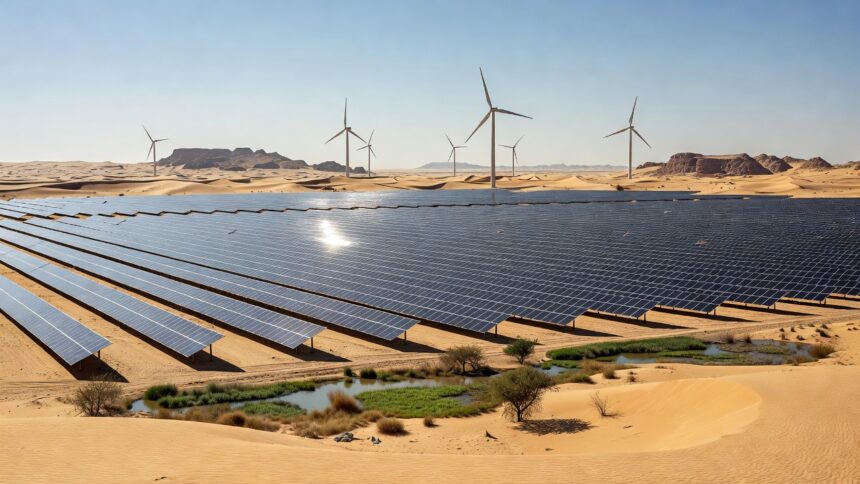
Desalinated water production capacity has increased from 4.6 million cubic meters per day in 2016 to more than 16 million cubic meters today, with the private sector’s share rising from 26 percent in 2019 to 42 percent, according to figures cited by Alibrahim. Basic health coverage expanded from 84 percent in 2019 to 100 percent in 2024, supported by the Sehhaty digital platform that has served more than 31 million users and facilitated over 51 million instant consultations. Renewable energy capacity grew more than 500-fold from 24 megawatts in 2016 to 12.3 gigawatts in 2025, powering 1.1 million housing units compared with 150,000 in 2022, the minister stated while noting continued advances in clean fuels and carbon management.
Saudi Arabia has extended its development cooperation through a $500 million contribution to the Global Polio Eradication Initiative via KSrelief, which supports annual vaccination of 370 million children, Alibrahim told the forum. The Saudi Fund for Development has backed more than 800 projects in over 100 countries, and companies such as ACWA Power have committed roughly $7 billion to clean-energy initiatives in Africa over the past two years. Domestically the review highlighted ecological restoration in Wadi Hanifa, now spanning 120 kilometers and treating around 650,000 cubic meters of wastewater daily, along with the Saudi Royal Reserves program that protects distinct ecosystems and hundreds of endangered species, the minister said. Alibrahim acknowledged that wider labor participation must be matched by stronger well-being and financial inclusion while non-communicable diseases continue to pose risks to long-term health spending, and he indicated the next phase would emphasize productivity gains, private-sector competitiveness and higher-value exports.