
 ع
ع


The Ministry of Economy and Planning presented Saudi Arabia’s third Voluntary National Review at the 2026 High-level Political Forum on Sustainable Development in New York, demonstrating how Vision 2030 has driven measurable alignment with the UN 2030 Agenda across economic, social and environmental domains. Prepared through an inclusive process involving more than 140 entities from government, the private sector, academia, civil society and international partners, the document builds directly on the Kingdom’s earlier submissions in 2018 and 2023. It frames national efforts around a National Sustainable Development Plan that organises more than 90 priorities into nine integrated missions addressing outcomes for people, the economy and the environment while emphasising the principle of leaving no one behind.
According to the Voluntary National Review, substantial gains have materialised in water and food security where non-renewable groundwater use in agriculture halved from 19 billion cubic metres in 2016 to 9.1 billion in 2025 even as agricultural production rose 88 per cent to 12.6 million tonnes in 2024. Desalination output now surpasses 16 million cubic metres per day, irrigation efficiency has improved from 53 per cent to 62 per cent and treated wastewater reuse has increased from 17.26 per cent in 2019 to 31.95 per cent. These advances form part of broader resource management that supports both domestic needs and long-term sustainability targets.
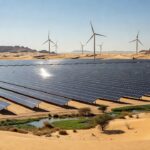
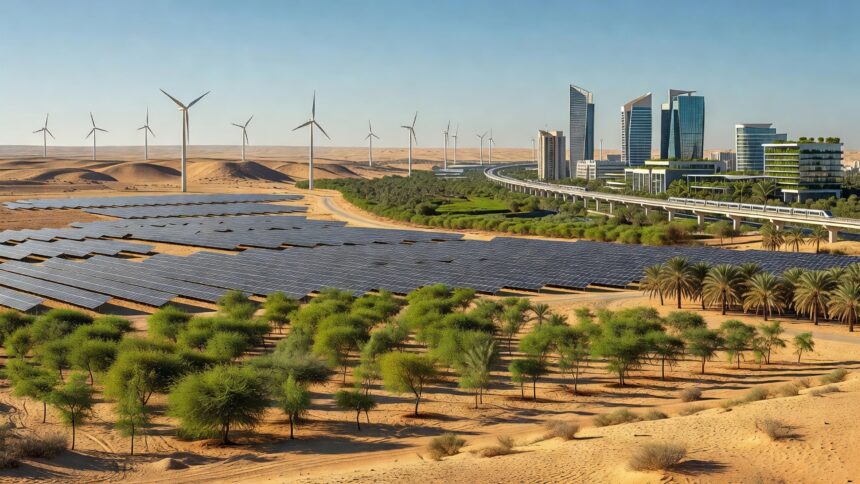
The review documented parallel momentum in energy, climate action and habitat protection as the Kingdom pursues roughly 50 per cent of its power generation capacity from renewable sources and energy storage by 2030. The Saudi Green Initiative has mobilised over 186 billion dollars and aims to reduce, avoid or remove 278 million tonnes of carbon dioxide equivalent annually by the end of the decade. Protected terrestrial areas expanded from 4.33 per cent to 18.8 per cent of national territory between 2016 and 2025, vegetation restoration increased thirteen-fold and more than 150 million seedlings were planted while Saudi Arabia hosted UNCCD COP16 in 2024 and chairs the International Coral Reef Initiative.
Health and human development indicators cited in the Voluntary National Review show life expectancy reaching 79.7 years in 2024 with healthcare coverage rising from 84 per cent in 2019 to 97 per cent. Traffic fatalities declined 57 per cent since 2016 and 16 cities have secured World Health Organization Healthy Cities accreditation. Female labour force participation advanced to 34.2 per cent in 2025, surpassing the original 30 per cent target, while women occupied 44.2 per cent of management roles and the share of out-of-school children dropped from 3.41 per cent in 2021 to 0.53 per cent in 2024.
Economic and urban progress detailed by the Ministry of Economy and Planning includes non-oil exports climbing 113 per cent since 2016 to 515 billion Saudi riyals in 2024, an improvement in the Global Competitiveness Index ranking from 32nd to 17th and more than 1.68 million small and medium-sized enterprises registered by the first quarter of 2025. Real GDP growth registered 4.5 per cent in the fourth quarter of 2025, overall GDP exceeded one trillion dollars in 2023 and over 562,000 citizens entered private-sector employment last year, a 29 per cent year-on-year increase. Riyadh Metro has become operational, six cities advanced in the Smart City Index and Madinah ranked third globally in the UN-Habitat SDG Cities programme.
Minister of Economy and Planning Faisal Alibrahim highlighted the review’s forward-looking priorities that include strengthened prevention of non-communicable diseases, improved groundwater sustainability, faster rollout of renewable energy projects, expanded financial inclusion, enhanced biosecurity and national vaccine capabilities plus more robust data systems. The Ministry noted that these areas emerged from lessons learned during the inclusive preparation process and will guide the next implementation phase. Saudi Arabia’s ranking as the second-largest humanitarian aid donor globally in 2025 further illustrates its conviction that peace, security and international solidarity constitute essential preconditions for sustainable development worldwide.