
 ع
ع


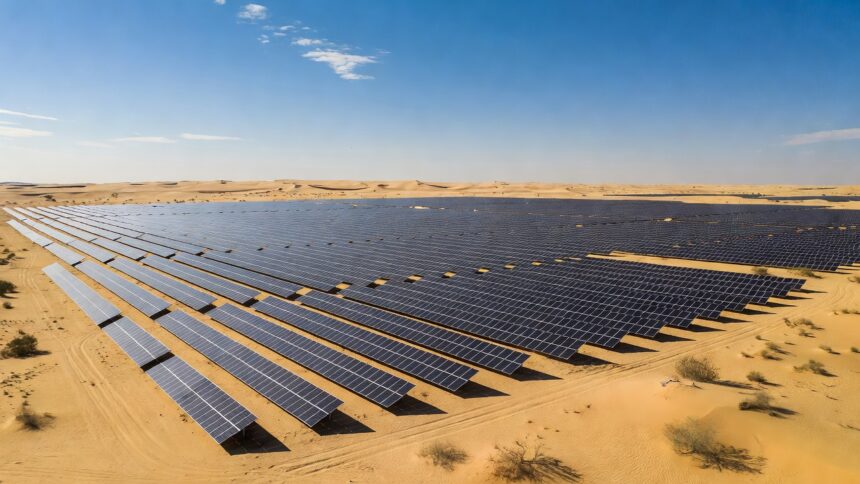
The General Authority for Statistics placed Saudi Arabia’s operated renewable energy capacity at 12,313 megawatts at the end of 2025, an 88 percent increase from the previous year according to its Renewable Energy Statistics 2025 report. Five solar projects that entered service during the year contributed 5,762 megawatts of that total and drew investment of 16.27 billion Saudi riyals. The authority’s figures show cumulative investment across the 15 projects now in operation reached 36.11 billion riyals.
GASTAT data indicated that the weighted average production cost for these facilities stood at 6.60 halalas per kilowatt-hour. The same report noted that renewable energy schemes supplied approximately 2.08 million housing units throughout 2025, an 82.31 percent rise compared with 2024. Projects added last year alone powered 939,000 of those homes.
The authority’s assessment listed the largest individual investments in the 2025 cohort as the Al-Rass (2) solar project at 5.52 billion riyals and the Al-Kahfa solar project at 4.06 billion riyals. Production costs ranged as low as 6.30 halalas per kilowatt-hour at the Al Henakiyah (1) facility. GASTAT released the statistics on August 6, 2026.
Renewables Now reported in December 2025 that Saudi Arabia had connected 12.3 gigawatts of renewable energy capacity and 8 gigawatt-hours of battery storage to the national grid by year-end. A GlobalData assessment placed installed renewable capacity at around 13 gigawatts at the close of 2025. The Kingdom had tendered a cumulative 64 gigawatts of renewable projects by that point according to an ADIPEC sector briefing.
The Columbia University Center on Global Energy Policy has documented Saudi Arabia’s target to derive at least 50 percent of its electricity from renewable sources by 2030 through approximately 130 gigawatts of capacity. Operational renewable capacity stood at roughly 0.4 gigawatts when Vision 2030 launched in 2016 according to the same analysis. The 2025 expansion included major schemes such as the 2.6-gigawatt Al-Shuaibah solar plant and the 400-megawatt Dumat al-Jandal wind farm.