
 ع
ع


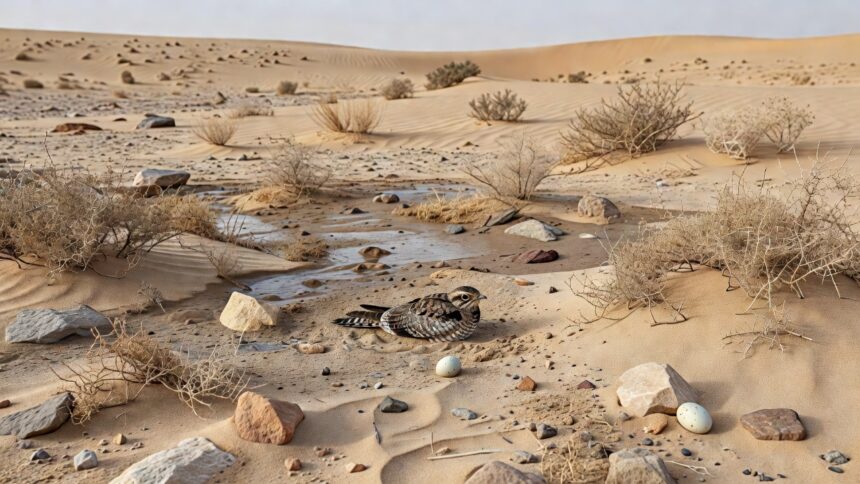
The King Abdulaziz Royal Reserve Development Authority reported the first confirmed nesting and breeding of the Egyptian Nightjar within Saudi Arabia after comprehensive field surveys at one of the protected area’s seasonal wetlands. Monitoring teams documented a clutch of two eggs laid directly on the ground with no conventional nest structure, a behavior typical for the species. On April 15, 2025, the teams located eggshell remains that verified the chicks had hatched successfully. Continued observations from mid-October onward showed repeated use of the site, indicating the birds had adapted to the habitat.
A peer-reviewed paper accepted for publication in Applied Ecology and Environmental Research and issued by ALÖKI Kft in Budapest presented the detailed findings from the reserve’s monitoring program. The study marked the transition of the Egyptian Nightjar record in the kingdom from possible occasional presence to verified breeding. The authority’s assessment found that the discovery expands scientific understanding of the species’ breeding distribution across the Arabian Peninsula. Researchers emphasized the value of extended nocturnal surveys in desert environments to capture data on elusive birds.
The International Union for Conservation of Nature lists the Egyptian Nightjar as Least Concern globally, yet the species remains uncommon and difficult to observe in Saudi Arabia due to its nocturnal habits and preference for remote desert terrain. Prior records had suggested potential nesting but lacked the direct evidence of eggs or hatched young now provided by the reserve’s work. The authority’s data places this confirmation as a milestone that builds on earlier wildlife documentation efforts across Saudi protected zones.
King Abdulaziz Royal Reserve spans diverse ecosystems that support specialized desert fauna, and the authority has recorded multiple first breeding confirmations for regional bird species in recent years. Separate scientific publications have detailed similar nesting successes for the Mediterranean short-toed lark and range expansions for the Black-winged Kite within the same reserve. These cumulative findings according to the authority demonstrate the protected area’s effectiveness in safeguarding habitats that sustain avian biodiversity.
Field methods employed by the reserve’s teams included systematic monitoring at Umm Al-Dhiyabah, identified as a unique seasonal wetland that retains moisture longer than surrounding arid zones. The authority noted that such sites prove critical for ground-nesting birds during breeding periods. Long-term environmental tracking programs have enabled the collection of precise seasonal data that shorter surveys would likely miss. This approach has allowed documentation of both initial nesting and subsequent bird activity at the location.
The reserve’s role in national conservation initiatives continues to grow through integration of research with habitat management practices. Authority figures show that expanding nighttime observation protocols has already yielded additional insights into previously under-recorded species. The Egyptian Nightjar discovery adds to a broader dataset that informs protection strategies for avian populations across Saudi Arabia’s varied landscapes.