ع



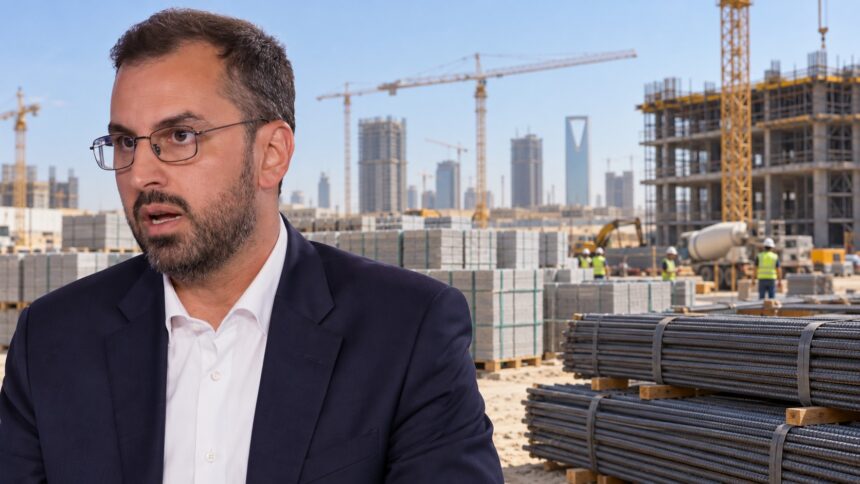
A market forecast to reach $191 billion in annual construction output is creating room for a new layer between contractors, suppliers and capital. BRKZ’s latest $31 million package shows what that layer can look like.
Saudi Arabia’s construction economy is approaching a scale at which procurement itself becomes infrastructure. Knight Frank’s Saudi Arabia Construction Landscape review puts total construction output at $148 billion in 2024 and forecasts $191 billion by the end of 2029. Across construction, industrial and transport, contracts worth $215.4 billion were awarded between 2020 and 2025. The flow has continued into this year: MEED Projects counted $61.1 billion of newly awarded contracts in the first eight months of 2026.
Those figures describe cranes, roads, buildings and infrastructure. Underneath them sits another economy built around quotes, purchase orders, factory capacity, delivery schedules and payment terms. Every project converts capital expenditure into thousands of individual material transactions. At Saudi scale, the companies connecting those transactions are increasingly becoming part of the market’s financial architecture as well as its supply chain.
Capital follows the procurement flow
That is the significance of the financing BRKZ announced on 14 September. The Riyadh-headquartered company secured $31 million in new capital, comprising $13 million in Series B equity co-led by Wa’ed Ventures and 500 Global and an $18 million growth-debt commitment from Stride Ventures under an existing $30 million facility. BRKZ’s September funding announcement says the company has now raised more than $70 million across equity and debt since its 2022 founding.
The structure matters. Equity finances technology and expansion; growth debt supports working capital and flexible commercial terms for customers. The procurement platform therefore sits at the point where a contractor selects material, confirms a supplier, arranges fulfilment and can align payment terms with the commercial cycle of the project.
That direction was already visible in October 2025, when BRKZ announced its original Stride Ventures facility. Founder and CEO Ibrahim Manna said at the time: “This growth debt facility from Stride Ventures strengthens our ability to support contractors and factories with more flexible payment and financing enablement options.” The 29 October 2025 announcement positioned embedded finance directly alongside materials procurement.
From marketplace to infrastructure layer
BRKZ now says more than 1,500 contracting companies and 150 building-materials factories use its platform, supported by approximately 2,100 local and international suppliers. Company-reported figures put cumulative materials sold above SAR500 million, or about $133 million, while requests for quotation processed on the platform exceed SAR5.13 billion, roughly $1.37 billion.
The footprint puts the business inside some of the Kingdom’s most visible development programmes. BRKZ says it supplies businesses participating in The Red Sea Project, Diriyah, Qiddiya, ROSHN and King Salman Park. Earlier this year, the Saudi Industrial Investment Company, the investment arm of the Saudi Industrial Development Fund, also took a strategic stake. SIC described its April investment as part of a wider effort to digitalise industrial procurement and strengthen Saudi supply chains.
There is a broader Vision 2030 logic here. As the Kingdom expands physical infrastructure, it is simultaneously building domestic platforms capable of organising the commercial activity around it. Procurement technology, local factory participation, international sourcing and financing can all sit inside the same relationship rather than operating as separate services.
The value is in the connection
BRKZ is one participant in a construction ecosystem that spans developers, contractors, manufacturers, distributors, banks and logistics providers. Its relevance comes from connecting several of those layers at the transaction level. The larger the Saudi project economy becomes, the more valuable that connective infrastructure can become.
The latest financing therefore says more than the headline $31 million. It shows capital moving toward the operating systems behind construction itself. Saudi Arabia’s $191 billion output forecast is usually read as a measure of how much the Kingdom will build. It can also be read as a measure of how much procurement, financing and supply-chain infrastructure will be needed to build it.