
 ع
ع


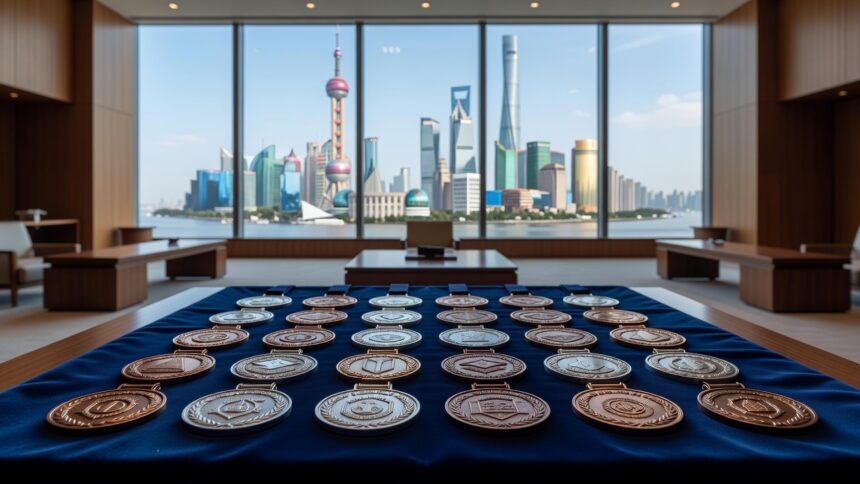
The King Abdulaziz and His Companions Foundation for Giftedness and Creativity reported that Saudi Arabia’s team secured three silver medals and three bronze medals at the 67th International Mathematical Olympiad in Shanghai. The foundation, commonly referred to as Mawhiba, noted that the competition drew 666 students from 117 countries between July 10 and 21. This latest success brings the kingdom’s total international mathematics awards to 88. Mawhiba coordinated the team’s year-long training program alongside the Ministry of Education. The program featured intensive theoretical and practical sessions designed to prepare participants for the demanding problems at the event.
Silver medals went to Yousef Ayman Bakhit of the Royal Commission for Education in Yanbu, Abdulsalam Abdullah Al-Sulami from Madinah’s General Directorate of Education and Abdulilah Mohammed Al-Saqqaf of Jeddah’s education authorities. Bronze medals were awarded to Elias Shaker Al-Faraj, Abdullah Tariq Al-Amer from the Eastern Province General Directorate of Education and Faris Mohammed Al-Kunhail from Riyadh. The foundation listed the affiliations for each medalist in its announcement detailing the results. Such individual achievements highlight the distributed nature of gifted education across Saudi regions. The official IMO results page confirmed the team’s overall standing among participating nations.
Saudi Arabia began competing in the International Mathematical Olympiad in 2004 and has now participated 21 times, according to the event’s official country profile. The competition itself traces its origins to 1959 when it was first held in Romania and has since grown into the premier contest for high school mathematicians worldwide. Sultan Albarakati served as the team leader for the Saudi contingent at this year’s edition. Hamza Alshaikhi acted as the deputy leader during the Shanghai gathering. The national mathematical olympiad committee maintains close ties with the global organization through Mawhiba’s oversight.
Mawhiba and the Ministry of Education have jointly developed a structured pathway for identifying and nurturing mathematical talent across the country. Candidates undergo several rounds of local and national competitions before advancing to specialized training camps. The preparation includes exposure to problems from past Olympiads and mentorship from experienced mathematicians. This systematic approach has contributed to the steady increase in Saudi medals over the years. The foundation’s efforts align with national goals to foster innovation and scientific excellence among youth.
The 2026 Olympiad marked another milestone for Saudi participation in international academic forums. With the event concluding on July 21, the medal counts were promptly updated on the official IMO database. Team members returned with enhanced skills and recognition that can inspire peers in their respective schools. The cumulative 88 awards span various global competitions organized under similar frameworks. Mawhiba continues to expand its portfolio of programs targeting different scientific disciplines.