
 ع
ع


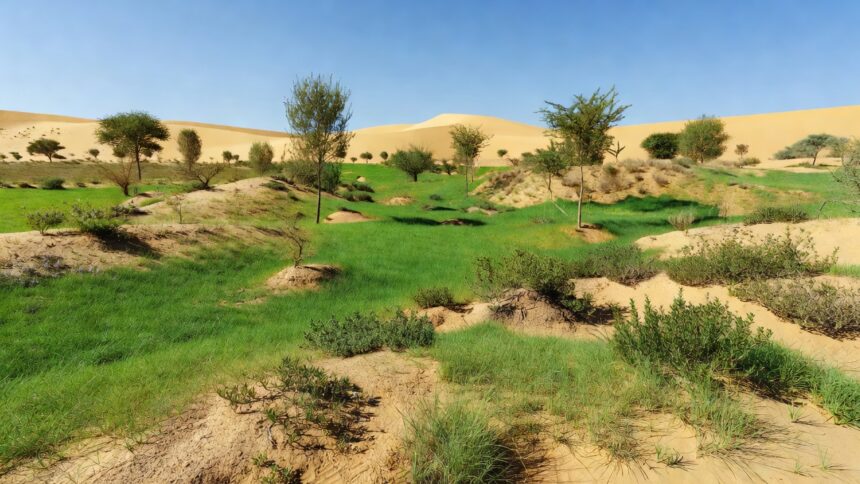
The United Nations on Wednesday awarded Saudi Arabia’s National Greening Program World Restoration Flagship status alongside initiatives from Brazil and the Sahel region as part of the UN Decade on Ecosystem Restoration, a joint UNEP and FAO press release stated during the 17th Conference of the Parties to the UN Convention to Combat Desertification in Ulaanbaatar, Mongolia. The three initiatives together commit to restoring nearly 5 million hectares by 2030, an area equivalent to almost 7 million football fields, contributing to the global pledge to rehabilitate 1 billion hectares under international agreements including the Paris climate accord and the Bonn Challenge. Saudi Arabia’s effort focuses on transforming degraded rangelands, forests, deserts, urban areas and coastal ecosystems including mangroves, according to the organizations.
Saudi Arabia’s National Greening Program had already brought 1 million hectares of degraded land under restoration and planted 159 million trees by June 2026, the UNEP and FAO assessment found. The program, led by the National Center for Vegetation Cover Development and Combating Desertification, employs techniques such as reforestation, natural regeneration, controlled grazing, rainwater harvesting and the deployment of treated wastewater in water-scarce areas. It has also supported the reintroduction of native wildlife including the Arabian oryx, gazelles and ibex.
The initiative aims to restore 2.5 million hectares and plant 215 million trees by 2030 while creating up to 187,000 jobs and enhancing urban air quality, building toward the Kingdom’s wider objective of restoring 40 million hectares and planting 10 billion trees by 2100, the release detailed. UN data places land degradation, drought and desertification among the central threats to food security and economic stability across arid regions, with the Saudi program positioned as a model for scaling effective responses. Previous World Restoration Flagships have demonstrated that such efforts can deliver measurable gains in biodiversity, carbon sequestration and community livelihoods when monitored transparently.
UNEP Executive Director Inger Andersen said, “The impacts of climate change, drought and desertification, as well as ongoing geopolitical tensions, are hitting global food systems hard.” She added that investing in healthy land stands as one of the strongest defenses against these threats and that the recognized initiatives illustrate how ecosystem restoration yields benefits including food security, new jobs and greater resilience for millions of people. FAO Director-General QU Dongyu stated that restoring degraded land must become a priority to meet commitments on food security, land degradation neutrality, biodiversity, food diversity and the climate crisis, noting that every hectare restored represents a step toward a more sustainable future.
UNCCD Executive Secretary Dr Yasmine Fouad observed that land degradation, drought and ecosystem loss have evolved beyond environmental concerns into fundamental challenges for food security, water security and economic stability. She highlighted that the World Restoration Flagships demonstrate restoration works and that investing in nature strengthens resilience while supporting livelihoods and delivering tangible benefits for people and communities. The Saudi program joins a network of 27 previously recognized flagships under the UN Decade on Ecosystem Restoration, whose progress undergoes tracking through the Framework for Ecosystem Restoration Monitoring.
Brazil’s Araticum Initiative, which engages more than 180 organizations to restore the biodiverse Cerrado savanna through natural regeneration and agroforestry, had placed over 27,000 hectares under restoration by June 2026 and targets 2 million hectares by 2030, UNEP figures show. The Sahel Integrated Resilience Initiative across five countries had restored more than 335,000 hectares while benefiting over 4 million people through soil management, livelihood support and school feeding programs, with a 2030 goal of 470,000 hectares. These recognitions underscore the emphasis on large-scale, long-term efforts that align restoration with improved food systems and climate resilience across drought-prone landscapes.