ع



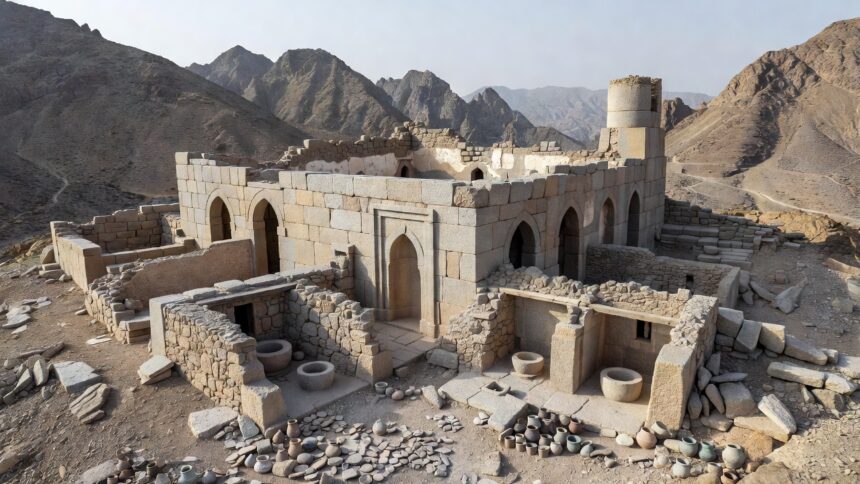
The Heritage Commission announced the completion of the fourth archaeological excavation season at the Al-Ma’mala site in Al-Baha with the uncovering of an ancient mosque believed to date from the first Hijri century. Built using trimmed granite stones on the western edge of the residential zone, the structure features a mihrab, several entrances and a minaret laid out in a plan that blends precision with simplicity of design. The mosque extends 16 meters north to south and 10 meters east to west while being bordered by attached stone rooms used for social and commercial purposes that contain storage areas, basins and architectural supports typical of local construction methods.
These latest findings add to evidence accumulated in earlier seasons that the Heritage Commission said demonstrated advanced urban development more than a millennium ago. Prior work at the location had exposed granite walls reinforced in places with mud bricks and finished with gypsum plaster, some standing between 50 and 120 centimeters high. The commission noted that associated discoveries included hundreds of pottery fragments bearing geometric patterns together with stone tools, colored glass and metal implements pointing to sustained commercial and industrial activity.
Al-Ma’mala occupies a strategic position 13 kilometers east of Al-Aqiq governorate and roughly 45 kilometers from the Al-Baha emirate center near the historic Darb Al-Feel caravan route that once linked southern Arabia with northern markets before Islam. The Saudi Press Agency reported that laboratory study of organic samples from previous digs confirmed mining operations at the site began in pre-Islamic periods and peaked from the late sixth through the ninth centuries. This economic role fostered a progression of settlements ranging from open mines to regional smelting centers according to commission assessments.
In a related development the Heritage Commission registered 184 additional cultural and archaeological sites across Al-Baha in October 2025 bringing the regional total to 313 as part of a national program to digitize and protect heritage resources. Abdulrahman Al-Ghamdi the commission branch director in Al-Baha stated that such listings enable creation of conservation plans and promote sustainable tourism while preserving traditional architecture built from local stone wood and other materials. These steps form part of wider efforts to document the Kingdom’s layered history and its contribution to regional trade networks.
Artifacts recovered during the fourth season encompass fragments of soapstone and pottery vessels along with grinders pestles and millstone pieces that illustrate aspects of daily life and artisanal skill. The Heritage Commission indicated that the combined seasons at Al-Ma’mala continue to refine understanding of how mining wealth supported religious and community infrastructure in the area. Further analysis of the newest material is expected to yield additional detail on the site’s occupation across successive historical periods.