ع



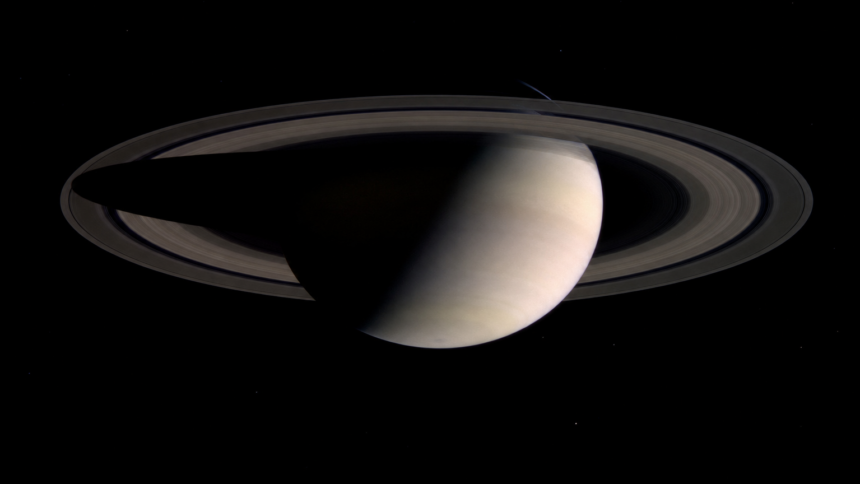
Saturn comes to opposition on October 4 placing it opposite the sun from Earth’s perspective and making the ringed planet visible throughout the night a forecast from BBC Sky at Night Magazine indicated. The event brings Saturn to a distance of 8.43 AU where it shines at magnitude 0.3 and displays an apparent disk of 19.7 arcseconds according to ephemeris data maintained by NASA’s Jet Propulsion Laboratory. Telescopes of modest aperture will reveal the planet’s rings tilted at 9.2 degrees offering improved views compared with the edge-on orientation seen in 2025 Space and Telescope reported.
The rings’ current opening allows observers to distinguish the Cassini Division under steady atmospheric conditions while Titan and other moons appear as distinct points of light near the planet a Sterngucker astronomical calendar noted. Opposition marks the annual peak for Saturn visibility with the planet culminating at its highest point in the sky around local midnight for most northern hemisphere locations. Data from the same assessment places the planet in the constellation Cetus where it remains well placed for observation through the remainder of the month.
Draconid meteors peak during the evening hours of October 8 and 9 with the radiant positioned high in Draco shortly after sunset according to predictions issued by the American Meteor Society. The shower typically produces slow bright meteors at a zenithal hourly rate of about 10 under dark skies though past outbursts have yielded hundreds per hour during certain years the society figures show. A nearly new moon on those dates will minimize interference allowing clearer detection even from suburban sites the society assessment found.
Orionid activity crests on October 21 and 22 as Earth intersects debris trails left by Halley’s Comet during previous passages National Geographic reported in its monthly sky guide. These swift meteors enter the atmosphere at 66 kilometers per second often leaving glowing trains visible for several seconds with expected rates between 15 and 25 per hour from dark locations. The shower’s radiant rises in the east after midnight making the predawn hours most productive once the moon has set according to the same compilation.
A new moon on October 10 opens an extended period of dark skies ideal for faint deep sky objects and additional planetary observations the Manitoba Museum sky calendar stated. The moon will pass near Jupiter on October 6 and approach Saturn later in the month creating striking conjunctions visible to the naked eye. Uranus reaches opposition on October 26 shining at magnitude 5.6 near the Pleiades cluster where binoculars suffice for detection under moonless conditions according to cross referenced data from multiple observatory previews.
Such events form part of the annual astronomical calendar that draws increasing public interest through outreach coordinated by organizations including the International Astronomical Union. Historical records maintained by the American Meteor Society document how similar October alignments have supported both amateur discoveries and educational programs at planetariums worldwide. Continued monitoring of these phenomena contributes to refined orbital models for cometary debris and planetary positions the Jet Propulsion Laboratory ephemerides demonstrate.