ع



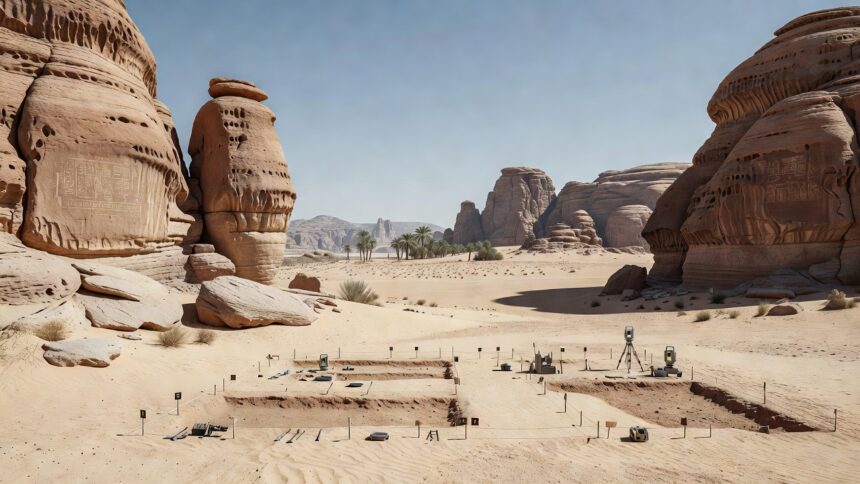
The Royal Commission for AlUla has opened its 2026-2027 archaeology season with coordinated fieldwork at heritage locations throughout AlUla County and the Khaybar oasis. Commission officials stated that the programme assembles specialists from King Saud University, the French National Centre for Scientific Research and other international institutions to continue excavations that have already transformed knowledge of ancient northwest Arabia. The Royal Commission for AlUla noted that teams will apply 3D scanning and linguistic studies to build digital records of inscriptions spanning the Iron Age to early Islamic periods.
Recent commission projects have documented more than 25,000 inscriptions across AlUla sites, according to a Royal Commission for AlUla assessment released this month. Jabal Ikmah contains prominent Dadanitic texts that earned UNESCO Memory of the World recognition in 2023, while Wadi Abu Oud features Lihyanite carvings illustrating daily life and tribal symbols. The commission’s inventory lists 19,802 rock art panels that include over 66,000 animal figures, 11,000 human depictions, 14,670 images of horses and riders and 1,375 battle scenes.
Neolithic research forms a central element of the season, building on prior discoveries of the oldest known architectural settlement in the Arabian Peninsula. The Royal Commission for AlUla reported that four intensive field seasons through May 2024 at a site near Tabuk uncovered semi-circular granite structures with hearths and storage areas dating between 11,000 and 10,300 years before present. Commission data indicate these findings, produced in partnership with Kanazawa University, demonstrate advanced planning for hunting and early grain cultivation.
Work at Dadan will examine a Late Antique village established around 250 AD after the abandonment of the earlier city, the Royal Commission for AlUla said. Previous analysis there recovered more than 167,000 animal remains that detail oasis life across two millennia. The commission’s statement added that Hegra, Saudi Arabia’s first UNESCO World Heritage site, will see continued investigation of Nabataean and Roman layers.
Khaybar surveys will target ancient water systems and evidence of sustained human occupation that complements studies at AlUla. According to the Royal Commission for AlUla, the season integrates community training for Saudi archaeologists and local residents to support documentation efforts. The commission has previously catalogued 180 scenes of human interactions with carnivores that shed light on survival strategies over millennia.
The programme aligns with preparations for a specialised cultural heritage research institute, the Royal Commission for AlUla indicated in its announcement. All generated data will contribute to the national archaeological register and peer-reviewed publications on the history of writing and human settlement in the region. Commission figures show these initiatives have already produced the first comprehensive descriptions of long-term Neolithic dwelling types in northwest Arabia.