

 ع
ع


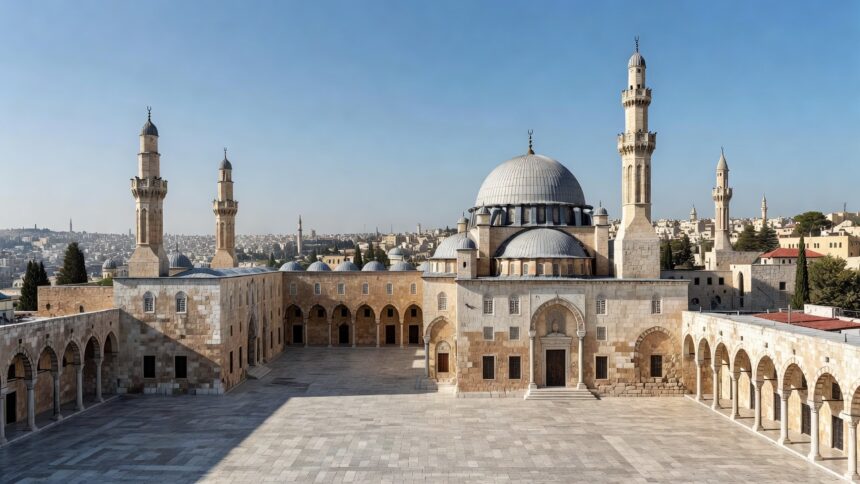
The foreign ministers of Saudi Arabia, Egypt, Jordan, Pakistan, Indonesia, Türkiye, Qatar and the United Arab Emirates released a joint statement on July 24, 2026, that strongly condemned what they termed Israeli escalation at Al-Aqsa Mosque, also known as Al-Haram Al-Sharif. According to the communique, which appears on the websites of several participating foreign ministries including that of the UAE, the provocative steps include continued mass incursions by Israeli settlers into the compound under protection of Israeli forces, visits led by Israeli ministers, raising of the Israeli flag inside the site and erection of two police tents. The ministers described these and related actions as unacceptable, warning that they fuel hatred, extremism and efforts to change the historical, legal and demographic character of occupied East Jerusalem while undermining prospects for a just and lasting peace based on the two-state solution. Similar joint statements by the same group of ministers have addressed parallel concerns in June 2026 and April 2026, records from the Turkish Ministry of Foreign Affairs indicate.
The statement highlighted incitement and calls encouraging further incursions and violence by Israeli extremist ministers and groups, according to the text. Such rhetoric and deeds constitute a flagrant breach of international law together with relevant United Nations resolutions and the longstanding status quo governing holy sites in occupied East Jerusalem, the ministers asserted. They cautioned that repeated violations risk inflaming regional tensions at a time when access to the Old City of Jerusalem has faced discriminatory restrictions that also violate established legal frameworks.
In their joint communique the ministers reaffirmed that Israel holds no sovereignty over occupied Jerusalem or its Islamic and Christian holy sites. They reiterated rejection of any attempt to alter the status quo at those locations and placed special emphasis on the historic Hashemite Custodianship over the Islamic and Christian places, a role formalized in the 1994 Jordan-Israel peace treaty and dating to 1924. The statement stressed that the full 144-dunum Al-Aqsa Mosque compound functions exclusively as a Muslim place of worship, with the Jerusalem Waqf and Al-Aqsa Mosque Affairs Department affiliated to Jordan’s Ministry of Awqaf and Islamic Affairs serving as the sole legitimate administrative authority.
The foreign ministers called on Israel as the occupying power to lift immediately all access restrictions imposed on Jerusalem’s Old City and to cease obstructing Muslim worshippers seeking to reach Al-Aqsa Mosque. They demanded an end to measures that infringe upon the sanctity of both Islamic and Christian holy sites throughout the city. The communique further urged Israel to refrain from all practices that violate the site’s established administrative and legal arrangements, a position consistent with multiple prior diplomatic initiatives by the eight nations this year.
According to the joint statement the ministers appealed to the broader international community to adopt a firm stance that compels Israel to terminate its ongoing violations and illegal practices directed at Jerusalem’s holy sites. This latest condemnation builds on a series of coordinated diplomatic messages issued throughout 2026 that have repeatedly invoked United Nations resolutions concerning Jerusalem and the occupied Palestinian territories. The Hashemite Custodianship, recognized internationally since the early 20th century and reaffirmed in various UN and bilateral documents, remains central to preserving the site’s character, Jordanian diplomatic records show.