
 ع
ع


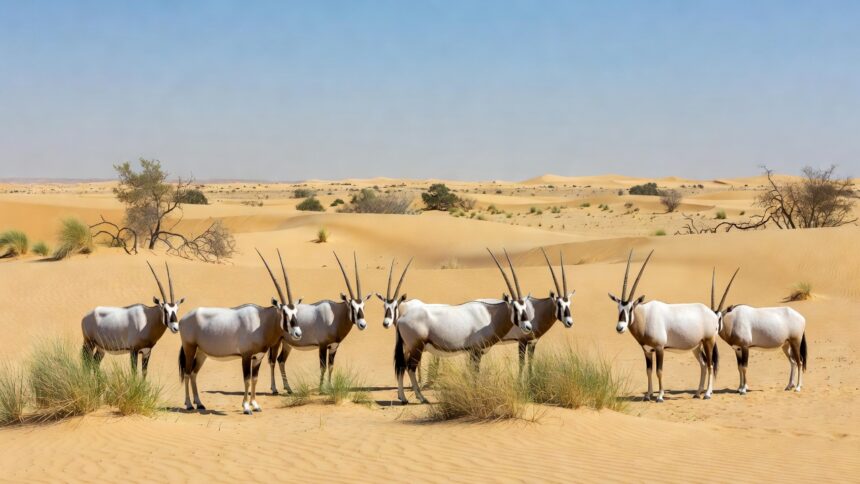
An assessment published by the International Union for Conservation of Nature moved the Arabian oryx to vulnerable status in 2011 after the antelope had been declared extinct in the wild two decades earlier. The three-category improvement from endangered followed sustained growth in reintroduced populations across the Arabian Peninsula. International Union for Conservation of Nature figures from that period placed the wild population at roughly 1,000 individuals, a total built entirely from captive breeding stock. The change marked the first time a species had advanced from extinct in the wild all the way to vulnerable on the IUCN Red List.
The National Center for Wildlife Development has documented continued expansion since the 2011 reassessment, with its 2026 data showing around 3,064 Arabian oryx living across 11 wild sites in Saudi Arabia. Populations at those locations have kept growing under coordinated monitoring and habitat management. The National Center for Wildlife Development has also recorded the species spreading through protected reserves where threats from unregulated hunting have been reduced. Saudi authorities began structured conservation breeding in 1986 and carried out the first reintroductions three years later at what is now the Imam Saud bin Abdulaziz Royal Reserve.
International Union for Conservation of Nature records show the last confirmed wild Arabian oryx was shot in Oman in 1972 after decades of overhunting across the region. The species, endemic to the Arabian Peninsula, had already vanished from much of its historic range by the middle of the 20th century. In response the International Union for Conservation of Nature and World Wildlife Fund launched Operation Oryx in the early 1960s to build a captive herd from the remaining animals held in collections. Saudi Arabia contributed to that global effort before launching its own national programme that combined scientific site assessments with genetic management of founder stock.
Conservation efforts documented by PANORAMA Solutions for Nature centre on the National Center for Wildlife Development’s work in breeding, habitat protection and post-release tracking. The programme selects release sites according to carrying capacity, vegetation health and long-term management resources. Local communities participate in planning and ongoing stewardship while veterinary teams ensure animals meet health standards before release. Protected areas now supply suitable habitat while regulations enforced by the Special Forces for Environmental Security limit poaching and other pressures.
The Arabian oryx plays a recognised role in desert ecosystems through seed dispersal, pruning of vegetation and support for plant regrowth, according to National Center for Wildlife Development assessments. As a cultural symbol of the Arabian Peninsula the species has helped focus national expertise in areas ranging from applied research to ranger training. The integrated approach has shifted from early individual releases to a broader system linking breeding centres, protected reserves and continuous population monitoring. Coordination among government bodies has strengthened data collection on animal movements and early threat detection.
Later surveys cited by the International Union for Conservation of Nature and independent reviews confirmed the upward trend that began before the 2011 decision, with wild numbers surpassing 1,200 by 2016 in Saudi Arabia alone. The National Center for Wildlife Development has since expanded the number of release sites while maintaining genetic diversity across the meta-population. Environmental regulations introduced in recent years have further reinforced protections for both the oryx and the wider desert landscape it inhabits. The programme continues to generate technical knowledge that Saudi authorities apply to other native species recovery initiatives.