ع



The Ministry of Hajj and Umrah has activated its integrated digital system to facilitate the journey of foreign pilgrims before they reach the Kingdom, according to an official statement published on its website. The Nusuk Masar platform connects contracting procedures, operational and field tasks with visa processing inside a unified digital infrastructure that reflects the expanded scope of digital transformation across Hajj services. This setup allows authorized digital channels to handle multiple requirements in an organized manner from the earliest stages of planning.
A clear digital timeline adopted by the ministry begins with the provision of campsite data and transfers to an electronic wallet before moving through contracting phases, pilgrim data uploads and group formations. The sequence ends with visa issuance and completion of all pre-arrival preparation information, the ministry reported. Such automation shortens processing times while raising execution efficiency and tracking precision prior to any pilgrim’s arrival.
The Nusuk application functions as a central tool within the expanding digital framework, with its user base exceeding 51 million people worldwide this year, according to ministry figures. Those users access more than 100 digital services, and 60 percent of them reside outside the Kingdom, the data shows. The high proportion of international users enables the platform to reach pilgrims early, allowing them to review services and permits through a single digital window.
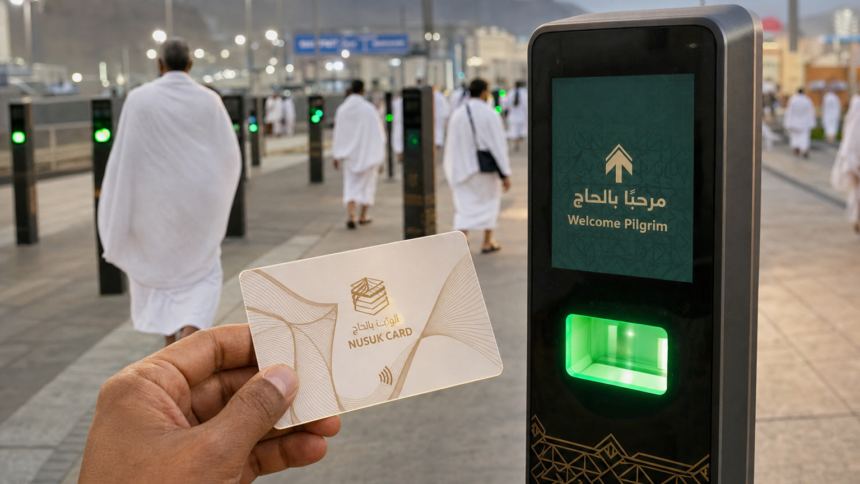
For the first time during this Hajj season the ministry has deployed a system of sensors and smart readers on the Nusuk Card to manage crowd movements and monitor field operations in real time. The technology also supports predictive modeling of pilgrim behavior across the holy sites, a ministry statement said. These capabilities improve the overall effectiveness of crowd management and the flow between different areas.
The initiative builds on the full migration of the Hajj and Umrah Data Center to cloud computing that was completed in June 2026, the Saudi Press Agency reported at the time. That transition, which involved more than 20 million annual pilgrims, strengthened business continuity and prepared systems for further digital expansion while integrating with over 70 domestic and international entities. The cloud-based foundation now underpins platforms such as Nusuk and the electronic Hajj portal.
Preparations through the Nusuk Masar platform form part of early readiness measures for the 1448 Hajj season, the Ministry of Hajj and Umrah stated. Electronic contracting simplifies relationships among Hajj affairs offices, foreign agencies and service providers while maintaining transparency across all steps. The system supports both core services at holy sites and optional additions tailored to different pilgrim groups.