
 ع
ع


The head of the Jeddah Astronomy Society, Majed Abu Zahra, detailed the trajectory of the total solar eclipse scheduled for August 12, 2026. Abu Zahra reported that the event will be visible in totality from sections of Russia, Greenland, Iceland, northern Spain and Portugal, where the longest period of darkness will last approximately two minutes and 18 seconds. He stressed that neither Saudi Arabia nor any Arab country lies in the path of totality for the eclipse.
A NASA Science overview of the August 12, 2026, eclipse confirms the path of totality sweeps across those northern regions while producing only partial coverage in parts of northwestern Africa and Europe. The assessment found that the eclipse begins at 15:34 GMT, with totality running from 16:58 GMT to 18:34 GMT before the partial phase ends globally at 19:57 GMT. This data aligns with local experts’ observations that partial visibility reaches limited areas in Morocco, Algeria, Tunisia, Mauritania and Libya but skips the Arabian Peninsula.
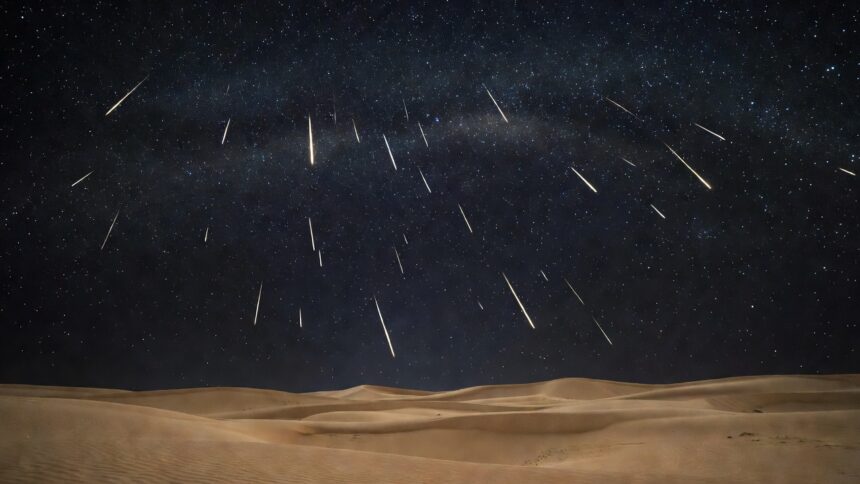
The Saudi Space Agency has reported that the Perseid meteor shower will reach its annual peak during the night of August 12 through dawn on August 13. Agency figures show observers in Saudi Arabia can expect between 75 and 100 meteors per hour under dark-sky conditions, with the optimal window running from 1 a.m. until sunrise. The shower coincides with the eclipse date but offers an independent celestial display for residents across the Kingdom.
Abu Zahra explained that the Perseids originate from debris shed by Comet Swift-Tuttle, with the meteors appearing to radiate from the constellation Perseus. The expert noted that the shower frequently produces exceptionally bright fireballs that enhance its visibility even from suburban locations when the moon is absent. Such characteristics have made the Perseids one of the most observed annual meteor events according to established astronomical records.
Data from NASA places the Perseid meteor shower among the most consistent yearly displays, with reliable peaks tied to the comet’s 133-year orbit that last brought it close to the sun in 1992. Previous strong outbursts have occasionally exceeded 100 meteors per hour when Earth passes through denser debris trails, though 2026 rates are projected within the standard range. The space agency has tracked the shower for decades, providing forecasts that local Saudi observers can use to plan viewing sessions.
The Jeddah Astronomy Society has encouraged residents to seek locations away from urban light pollution to maximize the meteor viewing experience on August 12-13. Abu Zahra advised allowing at least 20 minutes for eyes to adapt to darkness while avoiding bright screens or flashlights during observation. Such preparations, combined with clear forecasts, position the Kingdom for an accessible astronomical event that requires no specialized equipment beyond patience and a dark vantage point.