ع



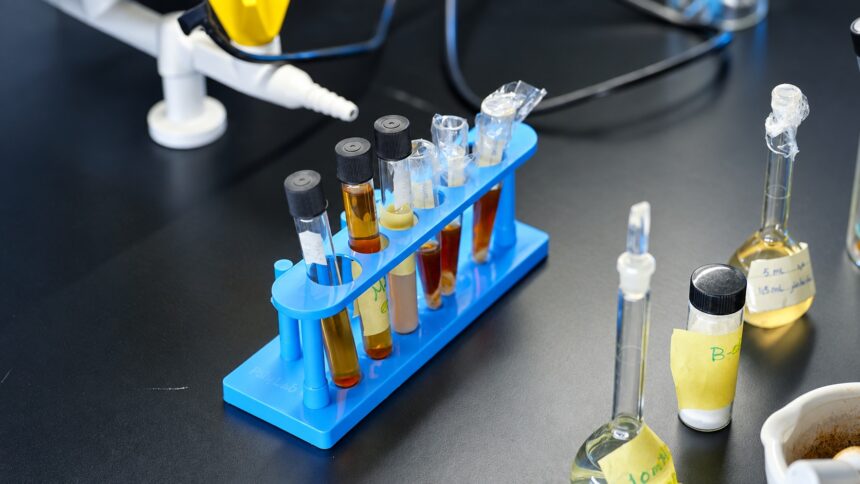
Newly funded AREP is linking practical laboratory education with plans for a scientific-supplies marketplace as Saudi research spending expands.
A laboratory can have expensive equipment and still face a basic problem: the person preparing an experiment needs practical training, and the correct materials must be available when the work begins. Saudi startup AREP is building a business around connecting those two requirements as the Kingdom expands its research economy.
The company, whose name stands for Academic Research and Educational Platform, has closed an undisclosed pre-seed funding round led by Golden Assets Investment. The announcement published on 21 September says the money will support product development and expansion in Saudi Arabia, with potential regional growth to follow.
Founded in 2023 by Hussain Alhamami, Ibrahim Asiri, Rayan Ahmed and Alhanouf Alhmammi, AREP combines an academy for laboratory education with a marketplace being developed for scientific supplies. Its proposition puts attention on a less visible part of the research economy: the preparation and purchasing that happen before an experiment produces a result.
A growing research economy needs practical capacity
Saudi Arabia’s research ambitions are increasingly backed by measurable spending. According to the General Authority for Statistics’ 2024 results, national research and development expenditure reached approximately SAR29.48 billion, up 30.4% from 2023. Employment in the field rose 14.7% to 56,593 people.
The spending was spread across several types of institution. Businesses accounted for 40.3%, government for 40.2% and higher education for 19.5%. That distribution matters because the research economy extends beyond university campuses, bringing commercial organisations and public institutions into the same broader demand for people, facilities and specialist services.
These are national figures, not a measure of AREP’s market share or revenue opportunity. They nevertheless establish the setting in which companies supplying research services are emerging. As expenditure and employment grow, the systems supporting day-to-day scientific work become a more substantial part of the story.
The next question is how that investment becomes usable capacity. A research budget can purchase equipment, but productive use also depends on staff preparation, access to facilities and the materials required for each project.
Bringing laboratory practice into the learning process
AREP’s academy focuses on the movement from understanding a technique to practising it. Its current course catalogue includes RNA extraction, gene knockdown and molecular genetics laboratory techniques, giving its education offering a specific scientific focus rather than the breadth of a general online-course platform.
The academy presents two learning routes: standalone video courses and a more extensive combination of video instruction, simulations, practice questions and in-person workshops. Its website also describes university-focused laboratory exam preparation.
The distinction is important. Recorded demonstrations can make a technique easier to revisit, while a workshop provides a setting in which the learner works with physical equipment. In AREP’s model, digital material is intended to sit alongside practical instruction.
Its catalogue shows how narrowly defined the subject matter can be. A learner may be seeking help with a particular laboratory method rather than another academic degree. That creates a different product-design task: making a specific procedure understandable, repeatable and relevant to the setting in which it will be used.
The academy currently labels its site as a beta version. Its public materials therefore offer a view of a developing service, rather than evidence that the full training model has already reached scale.
Connecting a lesson to the supplies it requires
The second part of the business addresses what happens when a learner or researcher needs the materials used in an experiment. On AREP’s main website, the proposed marketplace links scientific equipment and consumables with the academy’s educational content.
The company describes plans for supplier comparisons, product specifications, order tracking and access to consumables used in selected experiments. As of 28 September, however, the homepage still labels the marketplace as coming soon. The distinction between the operating academy and the marketplace under development is important when assessing the new funding.
The commercial idea is a connection between learning and purchasing. Someone studying a technique may also need to identify suitable materials; an institution teaching that technique may need to organise supplies for a group. Bringing those activities closer together could make the platform useful at more than one stage of laboratory preparation.
That remains a proposition to be tested through delivery. The funding announcement does not provide marketplace transaction volumes, customer numbers or independently measured procurement savings. Its immediate significance is that an investor is backing further development of the model.
A wider push towards biotechnology
The opportunity also sits within Saudi Arabia’s longer-term scientific priorities. The National Biotechnology Strategy announced in 2024 set out ambitions spanning vaccines, biomanufacturing, genomics and plant optimisation, with the aim of establishing the Kingdom as a regional biotechnology centre by 2030 and a global hub by 2040.
Those ambitions involve different industries and scientific disciplines, but they share a requirement for people capable of working in specialised environments. For training and supply businesses, the relevant opportunity is in the practical work needed to support that expansion.
AREP is not itself a measure of the strategy’s progress, nor does national investment guarantee demand for any one platform. The connection is more specific: laboratory education and access to research materials are supporting functions within a growing scientific economy.
For the startup, the next stage is consequently about execution inside Saudi Arabia. The announced funding is intended to develop products and widen local operations before a potential regional expansion. The test will be whether its combination of instruction, practical access and scientific supplies becomes useful enough for learners and institutions to return.
The story behind the investment is therefore larger than another education app securing capital. It is about building the everyday services that allow research spending to become research activity, from the first demonstration of a technique to the materials waiting on a laboratory bench.