ع



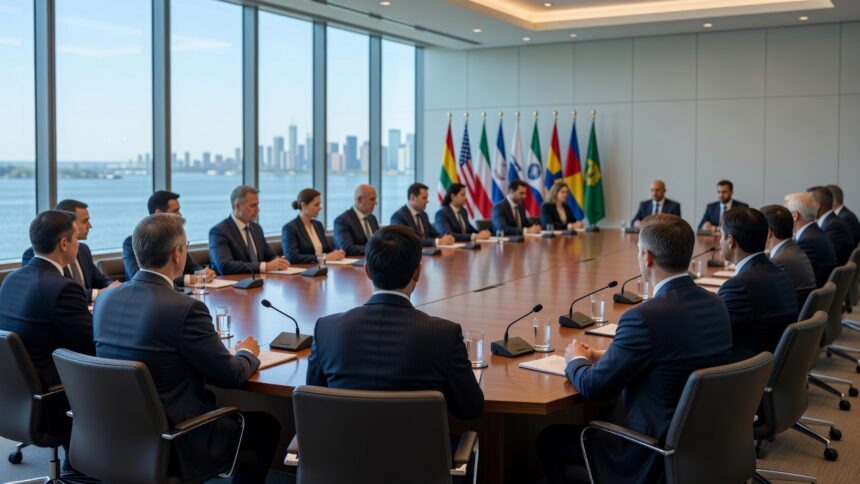
US President Donald Trump brought together senior officials from key Arab and Islamic nations in New York on the sidelines of the 81st session of the United Nations General Assembly, where discussions centered on the latest Middle East developments and strategies to limit escalation. According to a readout from the United Arab Emirates Ministry of Foreign Affairs, the gathering included King Abdullah II of Jordan, Qatar’s Emir Sheikh Tamim bin Hamad Al Thani, Turkish President Recep Tayyip Erdogan and Saudi Foreign Minister Prince Faisal bin Farhan among others. Participants examined challenges to security and freedom of navigation in the Strait of Hormuz and Bab al-Mandeb while stressing the need for diplomatic solutions to ongoing crises.
The meeting, convened at Trump’s invitation, reviewed collective efforts to prevent the expansion of current conflicts across the region, a statement distributed by participating foreign ministries indicated. Attendees included representatives from the GCC countries as well as Iraq, Syria, Lebanon and Egypt, reflecting a broad cross-section of regional stakeholders. Al Arabiya English reported that the talks highlighted the importance of coordinated political action to address security threats and maintain stability amid heightened tensions.
Regional de-escalation has formed a consistent theme in recent diplomatic engagements, including a series of Quad foreign ministers meetings that have taken place in Cairo and New York over the past several months. The UAE statement noted that Tuesday’s session built on those earlier consultations by focusing specifically on containing spillover risks and reinforcing maritime security. Officials exchanged views on how best to advance diplomatic tracks that could ease pressures on multiple fronts simultaneously.
Trump’s administration has maintained an active role in regional mediation, with US officials holding separate talks with Iranian representatives in New York earlier this week, multiple outlets including The Times of Israel reported. The president has publicly stated that such engagements produced positive momentum toward potential agreements while warning of severe consequences if diplomacy fails. This approach aligns with broader US objectives of preventing Iran from acquiring nuclear capabilities and safeguarding Gulf security interests.
Prince Faisal bin Farhan has engaged in intensive bilateral and multilateral discussions throughout the UNGA high-level week, including prior phone calls with counterparts from Kuwait, Egypt and Türkiye to align positions on containing tensions. The Saudi foreign minister’s participation in the Trump-convened session underscores Riyadh’s central role in these coordination efforts, according to coverage by Al Arabiya English. Such meetings have become a regular feature of GCC and broader regional diplomacy as countries navigate complex security dynamics.
The 81st UN General Assembly session has provided a platform for numerous side meetings addressing interconnected crises from the Middle East to Ukraine, a schedule outlined in advance by the US State Department showed. Foreign ministers have used the gathering to intensify consultations on de-escalation, with participants in Tuesday’s meeting agreeing to sustain close coordination in the coming weeks. These diplomatic exchanges occur against a backdrop of ongoing concerns over maritime security and the need to prevent any single conflict from destabilizing the wider region.