ع



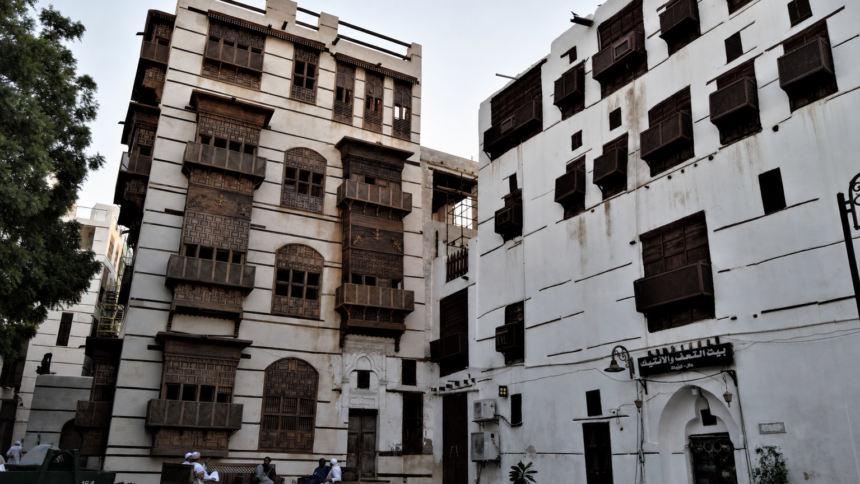
The Jeddah Mayoralty announced that the design guidelines for Hejazi coastal architecture which first took effect in May have now been incorporated into the municipal violations schedule making compliance compulsory for every new residential construction permit and all requests to renovate building facades across the city. Engineering offices that fail to apply the guidelines when submitting building permit applications face fines ranging from 1000 to 5000 riyals according to the municipal authority with penalties doubling for repeated offenses and a seven-day grace period to correct violations during which work remains suspended. Supervising offices and contractors that execute work contrary to the approved guidelines or that neglect to monitor implementation incur fines between 2000 and 10000 riyals the Jeddah Mayoralty clarified with similar doubling for repeats supervising offices receiving seven days to rectify while contractors are granted up to 30 days and permits halted until compliance is achieved.
Residential building owners who alter facade elements in ways that contradict the approved permit face penalties from 100 to 500 riyals under the Jeddah Mayoralty framework with fines doubling on subsequent violations and a 14-day window to restore the original design. The municipal authority stated that these measures support the creation of contemporary designs that reflect Hejazi coastal identity while maintaining structural efficiency and aesthetic qualities developed over centuries along the Red Sea shoreline. A color guide issued by the Jeddah Mayoralty in 2025 specifies approved palettes dominated by pearl white and sandy tones for at least 80 percent of facades with secondary accents drawn from traditional rawashin screens limited to no more than 20 percent of surfaces.
The guidelines form part of the national Saudi architecture map launched by Crown Prince Mohammed bin Salman that identifies 19 distinct regional styles each drawn from local geography and cultural heritage the official Saudi Architecture portal reported. Handbooks available on that portal for the Hejazi coastal style recommend graduated projections and setbacks to generate self-shading along with functional reuse of heritage features such as wooden screens for natural ventilation and daylight control. Materials drawn from the immediate coastal environment or compatible modern equivalents must predominate in prominent building elements according to the design directives published by the authority.
Historic Jeddah known locally as Al Balad features more than 650 heritage structures built primarily from coral stone harvested from the Red Sea with multi-story tower houses reaching heights of 30 meters or more a description provided on the Jeddah Mayoralty historical section of its website. The district earned UNESCO World Heritage inscription in 2014 under the title Historic Jeddah the Gate to Makkah in recognition of its role as a pilgrim hub that blended influences from trade routes across the Indian Ocean and Ottoman architectural traditions. Restoration efforts coordinated by the municipality in partnership with the Public Investment Fund have accelerated under Vision 2030 to preserve these structures while extending compatible design principles to new developments.
Application handbooks for residential villas and low-rise buildings in the Hejazi coastal style detail how traditional rawashin carved wooden window screens can be reinterpreted using contemporary fabrication methods without compromising their role in providing privacy and climate control the Saudi Architecture website stated. Maps distributed with the guidelines delineate zones where the style holds particular relevance along the Red Sea coast encompassing Jeddah Yanbu and Al Qunfudhah. The Jeddah Mayoralty has made the full suite of technical documents accessible through its digital platforms to assist engineering offices and contractors in meeting the newly mandatory standards.
Related municipal initiatives have brought more than 4000 buildings into compliance with broader urban design criteria in recent years through removal of visual distortions and verification of approved facades according to separate announcements from the authority. The current enforcement of Hejazi coastal guidelines builds on that foundation by embedding specific architectural requirements into the routine permitting process for residential properties. Engineering and supervisory offices must now reference the approved color charts and design handbooks at the earliest stage of permit preparation the Jeddah Mayoralty emphasised.